

Foreword
Customer support is entering a new phase. Businesses are no longer looking at customer experience as just faster replies or better ticket handling. In 2026, support teams are investing in personalization, AI, automation, customer insights, and connected communication channels to create smoother, faster, and more meaningful customer experiences.
To better understand how customer support is evolving, we gathered insights from more than 400 customer support professionals, managers, and decision-makers. These are individuals who work closely with customers every day. Responses were collected in two ways: one as polls during a recent Desk365 customer webinar and another as an industry-wide query distributed to customer service professionals via HARO.
This report explores how teams are balancing efficiency with empathy and what it takes to win customer trust in the AI era.
Here are some key findings:
1.
Personalization is becoming the new CX priority
Customer expectations are becoming more specific, contextual, and experience-driven. Businesses are recognizing that generic support experiences are no longer enough. Customers want brands to understand their history, needs, preferences, and previous interactions.
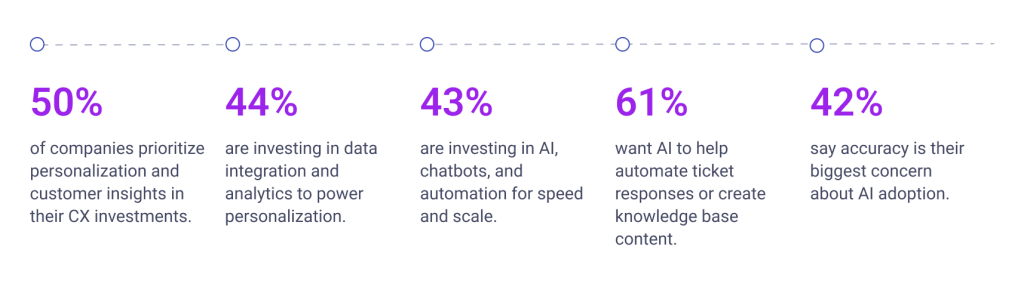
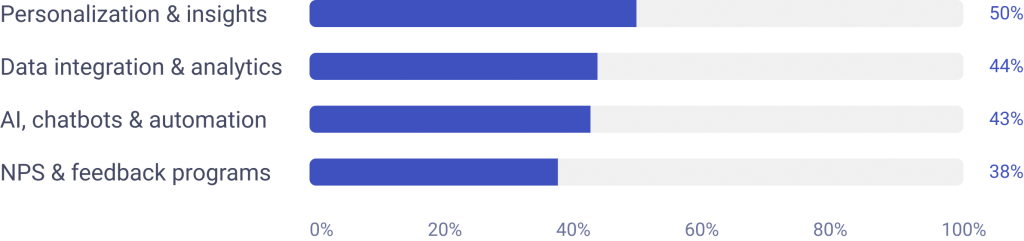
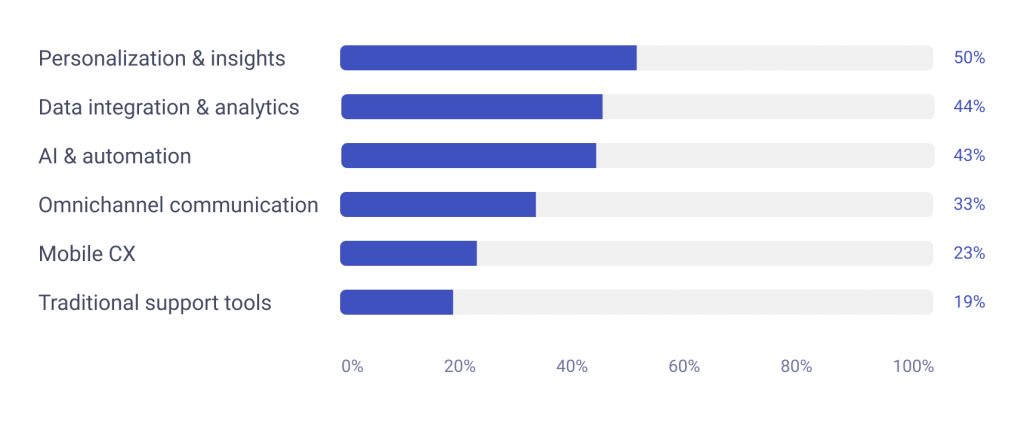
Our research found that 1 in 2 companies – almost half of the industry are prioritizing personalization and customer insights in their CX investments for 2026.
50%
of companies are prioritizing personalization and customer insights in their CX investments.
Top CX investment priorities for 2026
From answering tickets to delivering context
Companies are investing in deeper customer understanding so they can offer faster, more relevant, and more proactive support. The goal is not just to respond to customers, but to respond with context.
Why personalization is winning attention
Faster resolution
Agents who see customer history and product usage solve issues without back-and-forth.
Better self-service
Tailored knowledge base suggestions guide customers to the right answer immediately.
Proactive support
Behavioral signals let teams reach out before a customer files a ticket.
Stronger loyalty
Customers stay with brands that remember them — and reward them with referrals.
The takeaway:
Personalization is no longer just a marketing strategy. It is becoming a core part of how companies design customer support experiences.
2.
Data integration is the foundation for better personalization
Personalization cannot happen without connected data. Support teams need access to customer history, ticket details, product usage, previous conversations, feedback, and account-level insights.
That is why 44% of companies are investing in data integration and analytics to make personalization possible.
Without integrated data, support agents and AI tools operate with limited context. With connected data, businesses can deliver more accurate responses, identify patterns, and create more consistent customer experiences.
44%
of companies are investing in data integration and analytics.
What "integrated data" looks like in practice
Unified customer view
One profile combining tickets, conversations, billing, and product usage, so every agent starts informed.
Cross-system context
CRM, helpdesk, knowledge base, and product analytics talking to one another instead of in silos.
Pattern detection
Analytics surface recurring issues, at-risk accounts, and emerging customer trends.
3.
AI and Automation are becoming essential for scalable support
As support volumes increase, companies are looking for ways to respond faster without overwhelming their teams. AI, chatbots, and automation are becoming key parts of this shift.
43%
of companies are investing in AI, chatbots, and automation.
Why AI is catching on in support
Speed
AI answers common questions instantly, reducing customer wait times.
Cost-effective
Handles repetitive volume without expanding headcount
Always-on
Supports customers 24/7 across time zones, holidays, and overnight hours.
Improving over time
Learns from past tickets and resolved issues to get sharper with use.
AI as an enabler - not a replacement
AI is becoming a support enabler. Businesses are using it to automate routine tasks, speed up ticket handling, and free human agents to focus on complex or high-value conversations.
Where AI earns its place in modern helpdesks
Auto-classifying and routing inbound tickets to
the right agent or queue.
Drafting first replies based on past resolutions and knowledge base content
Summarizing long ticket threads so handoffs don’t lose context.
Suggesting relevant help articles to customers and agents in real time.
Detecting sentiment and flagging tickets that need escalation.
Closing low-effort tickets like “thank you” replies automatically.
4.
Support teams want AI to reduce repetitive work
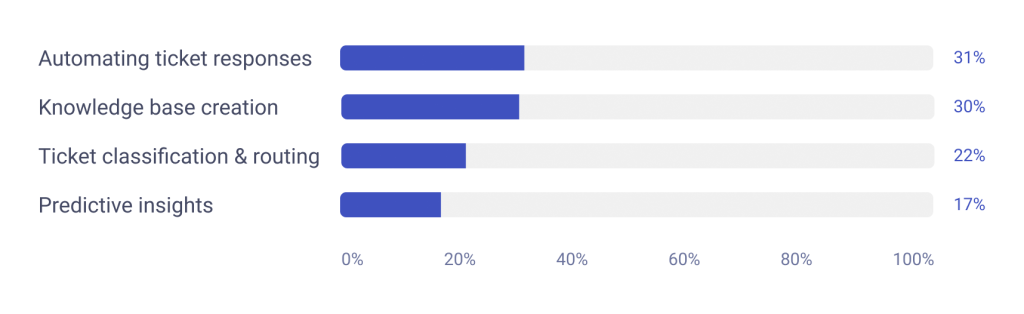
AI adoption is not just a broad strategy. Companies already know the specific areas where they want AI to help. Based on the reports,
61%
of respondents want AI to help with automating ticket responses or creating knowledge base content.
This includes,
Where support teams most want AI to help
What this means
Together, these two use cases show that support teams are looking for practical AI, not abstract AI. They want tools that reduce manual work, improve response quality, and make internal knowledge easier to use
5.
Trust remains the biggest barrier to AI adoption
Even though companies are investing in AI, adoption still comes with concerns. Businesses want AI to be fast, but they also need it to be reliable, secure, and accurate.
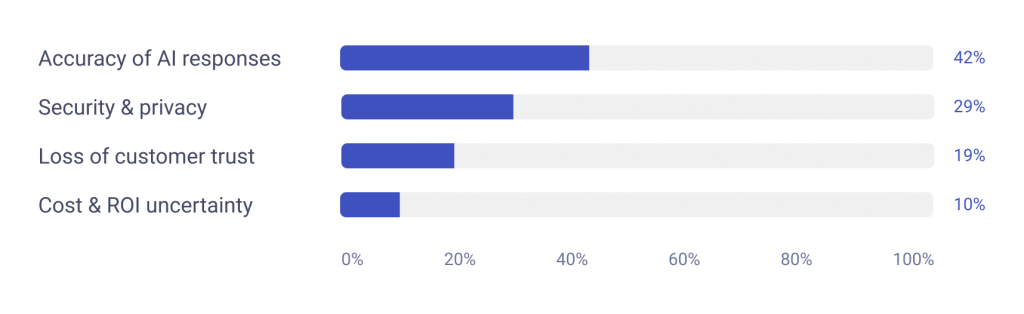
According to our poll data, 42% of companies say accuracy is their biggest concern about AI adoption.
Another 29% are concerned about security and privacy.
This shows that trust is the biggest challenge for AI in customer support. Companies are not just asking whether AI can help. They are asking whether AI can be trusted with customer conversations, sensitive information, and business-critical workflows.
Biggest concerns about AI adoption in customer support
For AI to succeed in support, it must be trusted
Companies are not just asking whether AI can help. They are asking whether AI can be trusted with customer conversations, sensitive information, and business-critical workflows.
6.
Feedback and NPS are becoming core CX signals
Customer support improvement depends on knowing what customers actually experience. That is why feedback loops are becoming a bigger part of CX strategy.
38%
of companies are making customer feedback and NPS programs a core part of their CX strategy.
Feedback and NPS programs help businesses measure satisfaction, identify friction, and understand
where support experiences need improvement.
How feedback turns into action
Spot patterns
Recurring negative feedback flags specific channels, agents, or product areas that need attention.
Close the loop
Following up with detractors turns one-time complaints into long-term loyalty.
Reward what works
Promoter comments reveal which support behaviors to scale across the team.
Guide investment
PS trends shape where to invest in training, tooling, and process improvements.
Continuous CX improvement, not annual audits
Companies are moving toward continuous CX improvement. Instead of relying only on internal assumptions, they are using customer feedback to guide support decisions in real time.
If your feedback program only surfaces problems at the end of the quarter, you’ve already lost the customer who reported them. The teams winning CX in 2026 read feedback the day it arrives.
7.
Omnichannel communication is becoming more important
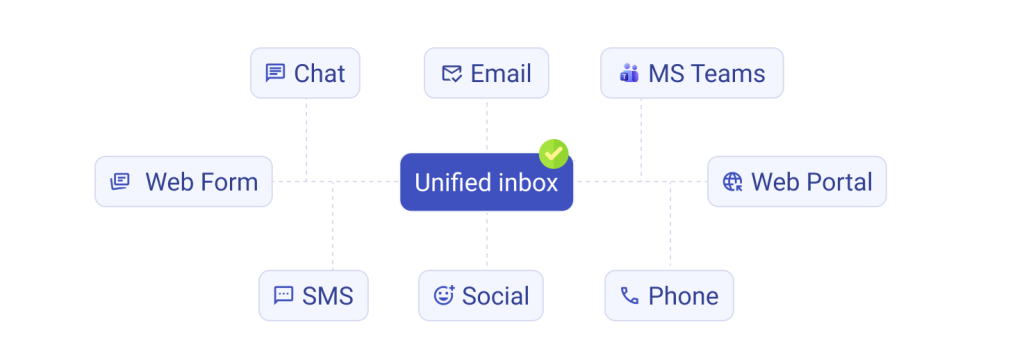
Customers now interact with businesses across multiple channels – email, chat, social media, phone, portals, mobile apps, and even Microsoft Teams. They expect these interactions to feel connected.
33%
of companies are actively improving omnichannel communication.
What this means
A strong omnichannel strategy ensures customers do not have to repeat themselves every time they switch channels. It also helps agents access the right context, regardless of where the conversation
started.
Hallmarks of a truly omnichannel helpdesk
A single ticket history that follows the customer across email, chat, phone, and portal.
Agents see the full context the moment a conversation lands in their queue.
Customers can switch channels mid-conversation without re-explaining anything.
Reporting rolls up across channels, not in separate dashboards per tool.
Automations and SLAs work the same way regardless of where a ticket starts.
Customers self-serve through portals and Al before reaching a human – by choice.
8.
Mobile CX still needs more attention
Mobile is now a major part of how customers interact with businesses. Customers expect support experiences to be fast, simple, and accessible from their phones.
23%
of companies are actively improving mobile CX.
What this means
Mobile CX is still under-prioritized. As customers continue to rely on mobile-first interactions, businesses will need to invest more in mobile-friendly support experiences, responsive portals, mobile chat, push notifications, and lightweight self-service.
Mobile is no longer a secondary channel. For most customers under 35, it’s the first and often the only way they’ll ever try to reach support. Teams that treat the mobile experience as an afterthought will quietly lose those customers.
9.
Traditional support tools are no longer the main investment focus
Support tools like live chat and help desks are still important, but they are no longer the only area where companies are investing.
Our research found that only 19% of businesses are currently improving traditional support tools, such as live chat or help desks.
CX investment focus in 2026 — where the new dollars are going
Traditional tools are now table stakes
This shift suggests that businesses are moving their focus from basic support infrastructure to more advanced CX capabilities – AI, automation, analytics, personalization, and omnichannel experiences.
The new expectation for any modern helpdesk
A solid ticketing core is assumed, not a selling point.
AI Assistance is built into the agent’s daily workflow, not bolted on.
Integrations with CRM, product, and analytics
are out-of-the-box.
Reports tie support metrics back to revenue,
retention, and NPS.
Customers can self-serve through smart
portals as a real first option.
Mobile and desktop experiences are equally
polished.
In other words, the question is no longer “do we have a helpdesk?” It’s “what does our helpdesk help
us do?”
So, what's the verdict?
The future of customer support in 2026 will be shaped by three major forces: AI, customer experience, and automation.
Our research shows that businesses are prioritizing personalization, investing in data integration, adopting AI, improving feedback loops, and building more connected communication channels. At the same time, companies remain cautious about AI accuracy, security, and privacy.
The direction is clear: support teams are not simply trying to answer more tickets. They are trying to create better, faster, and more intelligent customer experiences.
Companies that succeed in 2026 will be the ones that combine human expertise with AI-powered efficiency, connected data, and customer-first support design.


 AI Agent
 Asset Management
 Knowledge Base
 Automations
 SLAs
SLAs
 Customization
 Ticket Assignment
 Reports & Analytics
 Approval Management
 Helpdesk Security
 Explore All Features
 Banking and Finance
 Healthcare
 MSP
MSP Government
  Non Profit
 IT Services
 Customer Support
 Human Resources
 Facilities