

Many teams struggle with handling requests that arrive from too many places. Emails, chats, spreadsheets, and verbal requests quickly become impossible to track. If you have ever lost a ticket, forgotten a request, or duplicated work, you already know how messy support processes can get.
Paying for a separate helpdesk tool can feel unnecessary, especially when your team already uses ClickUp for project management. Some teams try to force rigid ticketing software to fit their workflow, only to realize it does not match how they actually work.
Managers often lack visibility into what is being worked on, who owns each ticket, and how long issues are taking to resolve. Support teams get overwhelmed when they cannot prioritize properly or automate repetitive steps.
When support tickets are disconnected from development or operations work, issues take longer to fix. That is why many teams have started looking for a ticketing system inside ClickUp. It allows them to centralize requests, customize workflows, and manage everything in one place.
Let’s have a look at how you can use ClickUp as a ticketing system.
TL;DR - ClickUp ticketing system
Support requests get messy when they come from too many places. Teams lose tickets, duplicate work, and lack visibility. ClickUp can work as a ticketing system by turning requests into tasks with custom statuses, fields, forms, automations, and dashboards. It centralizes requests, connects tickets to real work, and reduces costs.
Pros: flexible, customizable, affordable, good visibility
Cons: not a native helpdesk, manual SLA/email setup, can get complex, not ideal for high volume
ClickUp is a good DIY ticketing option for small–mid teams. If you want a ready-made, full-featured helpdesk in Microsoft Teams, Desk365 is a faster alternative starting at $12.
Why use ClickUp as a ticketing system?
Many teams already use ClickUp to manage projects and tasks. Turning it into a ticketing system simply makes sense.
Instead of juggling a separate helpdesk tool, spreadsheets, and inboxes, everything lives in one place. ClickUp allows you to capture requests, bugs, and issues as tasks, then move them through a clear workflow from new to resolved.
You can customize statuses, fields, and automations so the system matches how your team actually works. It also gives managers real visibility into workload, priorities, and turnaround time.
Most importantly, tickets stay connected to the work that fixes them. No more copying information between tools or losing context. For many teams, ClickUp has become a flexible, affordable alternative to traditional ticketing software.
What are the benefits of ClickUp ticketing system?
Centralized request management
All tickets, requests, and issues live in one place. Instead of checking emails, chat messages, and spreadsheets, your team works from a single source of truth. Nothing slips through the cracks.
Customizable workflows
Clear ownership and accountability
Every ticket has an owner. Everyone knows who is responsible and what needs to happen next. This reduces confusion and finger-pointing.
Better visibility and reporting
Managers can quickly see how many tickets are open, in progress, or overdue. Dashboards and reports make it easy to spot bottlenecks and workload issues.
Automation that saves time
Routine steps like assigning tickets, changing statuses, or notifying stakeholders can be automated. This frees your team to focus on solving problems instead of managing them.
Connected to project work
Support tickets stay linked to development tasks, features, or internal projects. No more copying information between tools or losing context.
Lower software costs
You can avoid paying for a separate helpdesk platform. ClickUp becomes a flexible, all-in-one solution.
Scales with your team
Start with a simple ticket list. Add SLAs, automations, and advanced reporting as your team grows.
Steps to set up your ClickUp ticketing system
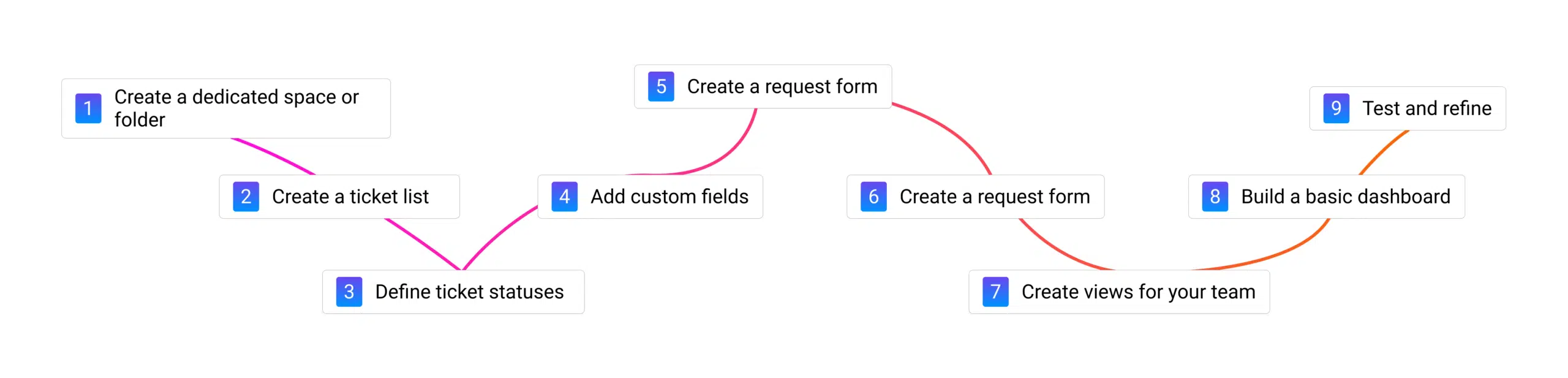
Step 1: Create a dedicated space or folder
Create a Space or Folder specifically for ticketing or support.
This keeps tickets separate from regular project tasks while staying in the same workspace.
Example names:
Support Desk, Help Center, Internal Requests, IT Tickets
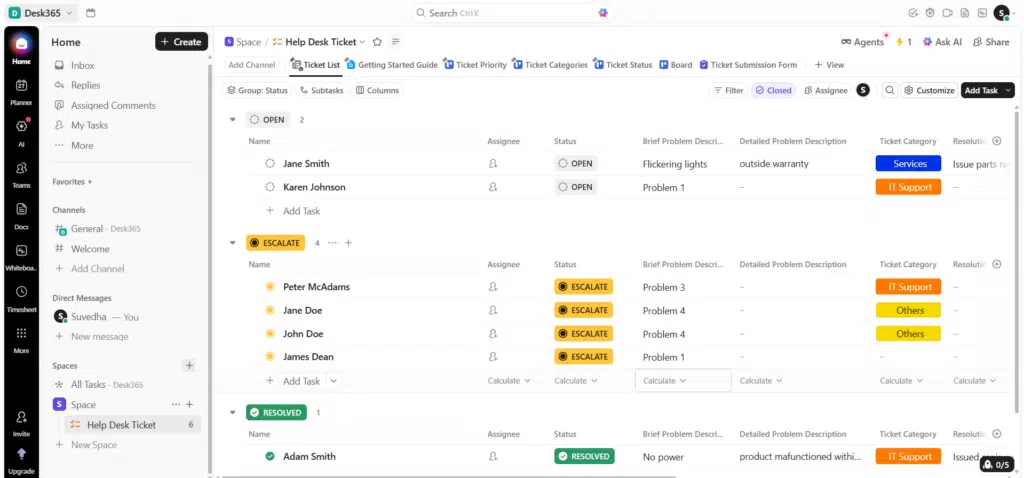
Step 2: Create a ticket list
Inside the space or folder, create a list that will hold all tickets.
Each task in this list will represent one ticket.
Example list name:
Support Tickets
Step 3: Define ticket statuses
Set up a simple workflow that shows the life cycle of a ticket.
Common statuses include:
- New
- In progress
- Waiting on the customer
- Waiting on the internal team
- Resolved
- Closed
Keep it simple at first. You can always add more later.
Step 4: Add custom fields
Custom fields store important ticket details.
Common fields include:
- Priority
- Category
- Requester
- Channel (email, form, chat, etc.)
- SLA or due date
These fields make sorting and reporting much easier.
Step 5: Create a request form
Use ClickUp Forms to capture incoming requests. When someone submits a form, ClickUp automatically creates a ticket. You can embed this form on your website or share it internally.
Step 6: Set up automations
Automation reduces manual work.
Examples:
- When a ticket is created, assign it to a team member
- When the status changes to resolved, notify the requester
- When priority is high, add a due date
Start with a few simple automations.
Step 7: Create views for your team
Views help different roles focus on what matters.
Examples:
- Open tickets view
- High priority tickets view
- My assigned tickets view
This keeps everyone organized.
Step 8: Build a basic dashboard
Create a dashboard with widgets for:
- Open tickets
- Tickets by status
- Tickets by assignee
- Average resolution time
This gives managers quick visibility.
Step 9: Test and refine
Run a few sample tickets through the system. Ask the team for feedback. Adjust statuses, fields, and automations as needed.
What are the limitations of ClickUp ticketing system?
Not a native helpdesk tool
ClickUp is primarily a project management platform. While it can be configured for ticketing, it does not come with built-in helpdesk features like some dedicated support tools.
Limited customer-facing portal
ClickUp does not provide this out of the box.
Email ticketing requires setup
Dedicated ticketing tools often include automatic email-to-ticket pipelines. With ClickUp, this usually requires additional configuration or integrations.
SLA management is manual
Service level agreements are not native features. Teams must rely on custom fields, due dates, and automations to approximate SLA tracking.
Reporting can require customization
While ClickUp has dashboards, advanced support metrics may need manual setup. Some reports may not be available by default.
Can become complex if overbuilt
Because ClickUp is highly flexible, setups can become complicated. Without clear standards, teams may struggle to maintain consistency.
Not ideal for very high-volume support
For teams handling thousands of tickets per day, a dedicated helpdesk platform may perform better.
Scales with your team
Start with a simple ticket list. Add SLAs, automations, and advanced reporting as your team grows.
Explore cloud-based ticketing systems
If you are considering using ClickUp for your ticketing system, here are a few points to think about.
Building a ticketing system inside ClickUp will give you a basic, functional setup rather than a fully featured helpdesk. If you are on a tight budget and need something quickly, this can be a sensible starting point.
However, setting everything up from scratch takes time and ongoing effort.
A pre-configured ticketing system may be a better option if you are short on time or prefer minimal customization. These systems are designed to be easy to use and come ready with common helpdesk features.
Choosing a pre-built ticketing platform allows you to launch faster and avoid the complexity of designing workflows yourself.
You may also want to consider Desk365, a Microsoft Teams ticketing system with a comprehensive feature set, starting at just $12. It provides an affordable and efficient way to meet your ticketing needs without stretching your budget
Omni-Channel
- Microsoft Teams Ticketing
- Email Ticketing
- Customer Support Portal
- Web Form/Web Widget
- Unified Inbox
Process Automation
- Workflow Automation
- Multiple Business Hours
- Custom Response Templates
- Canned Responses
- Tasks/To-do Lists
- 'Share To' Tickets
- Time Tracking
- SLA Management & Business Hours
- SLA Reminders & Escalations
- Multiple SLAs
- SLAs in Automations
Data & Analytics
- Customer Surveys & Reports
- Ticket Trend Reports
- Productivity/SLA Reports
- Export Data
- Scheduled Reports
- Import Data
Ticket Management
- Round Robin Ticket Assignments
- AI Copilot
- AI Agent
- Multilingual Helpdesk
- Multiple Business Hours
- Load Based Ticket Assignments
- Ticket Watchers
- Multiple Groups/Departments
- Collision Detection
- Scheduled Ticket Creation
- Closure Rules
- Knowledge Base
- Contact Management
Integrations
- Entra ID Single Sign-on
- Microsoft Entra ID Sync
- API Access
- Web-hooks
- Power Automate Connector
- Microsoft 365 Copilot Plugin
Customization
- Custom Email Servers
- Custom Domain
- Custom Ticket Fields
- Custom Forms
- Custom Roles
- Custom Reports & Graphs
- Remove Desk365 Branding
Support
- Free Setup and Installation
- Priority Support
Service Management
- Asset management
- Change management
Advanced Encryption
- PII and PHI Controls
- Data Redaction
- HIPAA Compliance
- Encrypted Field logs
Switch to Desk365 now, starting at just $12!
Frequently asked questions
No — ClickUp doesn’t include a dedicated, built-in ticketing/help-desk product in the same way tools like Zendesk, Desk365, Freshdesk, or Jira Service Management do, but you can create and use a ticketing system within ClickUp by configuring its task management features, or extend it with templates and integrations.
ClickUp is mainly used as an all-in-one work management and productivity platform. Think of it as a place to plan, track, and manage work across teams—projects, tasks, docs, goals, and workflows—all in one tool.
Jira is generally seen as better for software development teams and complex, highly structured work. ClickUp is generally seen as better for broad project & work management across different teams with less setup complexity.






 AI Agent
 Asset Management
 Knowledge Base
 Automations
 SLAs
SLAs
 Customization
 Ticket Assignment
 Reports & Analytics
 Approval Management
 Helpdesk Security
 Explore All Features
 Banking and Finance
 Healthcare
 MSP
MSP Government
  Non Profit
 IT Services
 Customer Support
 Human Resources
 Facilities