
If you manage IT services, you have the superpower of bringing order to chaos. Tickets get logged, SLAs get tracked, and incidents get resolved. Your team has a structure that most of the business does not.
But here is the problem you probably run into every week: HR is still managing onboarding through email threads. Facilities is handling maintenance requests over WhatsApp. Finance approvals are sitting in someone’s inbox waiting for a reply. And somehow, employees end up at your desk asking for help with things that have nothing to do with IT.
That is not an IT problem. That is an organization-wide service delivery problem. Enterprise service management is how you can fix it.
This post breaks down what ESM is, why it matters right now, and how IT managers are the ones best positioned to make it happen across the business.
What is enterprise service management?
Enterprise service management, or ESM, is the use of IT service management principles and capabilities in other business areas to improve their operational performance, services, experiences, and outcomes. In plain terms, it takes what IT has been doing well for years and applies that same discipline to HR, Finance, Legal, Facilities, and every other function that delivers services inside an organization.
The terminology matters less than the concept. A 2021 global survey by AXELOS and ITSM.tools found that “service management” and “digital transformation” are more popular names for this practice than “enterprise service management” itself, even though ESM remains the dominant term in vendor marketing and tooling conversations. You may also hear it called “beyond IT,” “shared services,” or “digital workflow enablement.” The label changes. The underlying idea does not.
What has changed is the scale of adoption. That same survey found that two-thirds of organizations (67.6%) currently have ESM strategies in flight, and over half of those were considered well advanced. That figure was just 7% in 2019. Only 11% of organizations now report having no plans for ESM at all.
ESM vs. ITSM: What is the difference?
ITSM is your domain. Incident management, change management, the service catalog, the help desk. Mature, structured, framework-driven.
ESM is what happens when you take that same discipline and extend it to HR, Finance, Facilities, and Legal. Same principles. Much bigger scope.
There are two ways organizations approach this:
A. Tactical ESM is the older model. One department, usually HR, gets access to your ticketing tool to get requests out of email. Useful as a quick fix, but it stops there.
B. Strategic ESM is where the real value is. It treats the entire organization as a network of service providers, each with structured workflows, SLAs, and visibility. It does not stop at HR. It grows through every function that has a request queue hiding in someone’s inbox.
For IT managers, tactical ESM is something you set up once and walk away from. Strategic ESM is something you build and grow. And it positions you as the person who made the whole organization run better, not just IT.
Benefits of enterprise service management
The top benefits organizations report from ESM are process standardization, digital transformation enablement, and employee productivity improvement. Here is what those mean on the ground.
- Fewer requests landing in the wrong place. Right now, when a new employee needs IT access, a desk assignment, system credentials, and HR paperwork on their first day, they are navigating four different systems or worse, coming to you because they do not know where else to go. ESM makes that one portal, one request. The routing happens behind the scenes.
- SLAs that exist outside of IT. HR and Facilities are probably managing work through email and spreadsheets with no SLA visibility at all. ESM changes that. When response times get measured, they improve.
- AI that handles the volume. Routine, high-volume requests like password resets, PTO approvals, equipment requests, and expense reimbursements do not need human hands. They need automation. ADP’s 2026 HR Trends Guide found that 84% of large organizations agreed AI can help streamline these processes without replacing people. The tools are ready. The question is whether your organization is using them.
- Metrics you can show upward. When service delivery is fragmented, no one has a clean picture. ESM gives you shared dashboards that HR directors, finance leads, and operations managers can all read, not just your IT team. That visibility makes your work legible to the people who control budgets.
Where ESM makes the biggest difference
The strongest use cases are wherever email and spreadsheets are doing the work that structured workflows should be doing. That describes most organizations in at least three or four departments at once.
- HR service management is where most teams start. Employee onboarding alone involves dozens of tasks across IT, HR, Facilities, and sometimes Finance. ESM turns that into a coordinated, trackable workflow with clear ownership at every step. No more chasing people to find out if a laptop has been ordered.
- Finance and procurement involve high volumes of repetitive approvals and status updates. Automating invoice routing, expense approvals, and vendor request workflows frees the finance team for actual analysis work, and means fewer people hunting down IT to ask why something has not been approved yet.
- Facilities is consistently underserved. Maintenance requests, room bookings, asset tracking. Most organizations handle these through informal channels with no SLA in sight. ESM gives facilities a proper queue and gives you visibility into what is being requested and whether it is getting done.
- Legal and compliance deal with a steady flow of contract reviews and compliance queries with no structured intake. ESM gives legal a service catalog and a queue. That is better for them and better for the people waiting for answers.
How to implement ESM without it becoming a distraction
ESM implementations that fail tend to fail for one of two reasons. Either the organization bought a platform and called it a transformation, or no one owned the cross-functional coordination that ESM actually requires.
Here is what works.
Start with a unified service catalog. Every department that delivers services needs a defined list of what they offer, at what SLA, through what channel. You probably have this for IT. HR, Finance, Legal, and Facilities almost certainly do not. Build it before you automate anything.
Build one employee-facing portal. The employee should not need to know which system to use. One front door. The routing logic lives behind the interface, not in front of it.
Automate the high-volume, low-complexity requests first. Identify the ten or fifteen request types that consume the most time across departments and build automated workflows for those before anything more complex. This is where the ROI case gets made quickly, and where you will find the easiest wins to show leadership.
Establish governance that spans functions. ESM needs ownership across departments, not just a platform license. That means defined accountability, regular service reviews, and a clear process for adding and retiring services. This is often where IT managers get stuck because it requires HR and Finance to actually commit to a structure they are not used to.
Make shared metrics visible. Volume trends, resolution times, SLA adherence. This data should not live only on your dashboard. When department heads can see how their services are performing, accountability follows naturally.
So recently, one Redditor basically asked this question, and it’s super common in large organizations:
The redditor’s team has ITSM working for IT, but other departments like HR and Facilities are still stuck in chaotic workflows, mostly emails, spreadsheets, and random messages. Requests get lost, duplicated, and it’s impossible to track work consistently across departments. They’re asking for a practical way to unify requests and workflows without doing a massive overhaul. They’re also weighing different approaches: extending the current ITSM platform, adding modules for other teams, or using separate tools that integrate. Basically, they want guidance on what works in the real world.
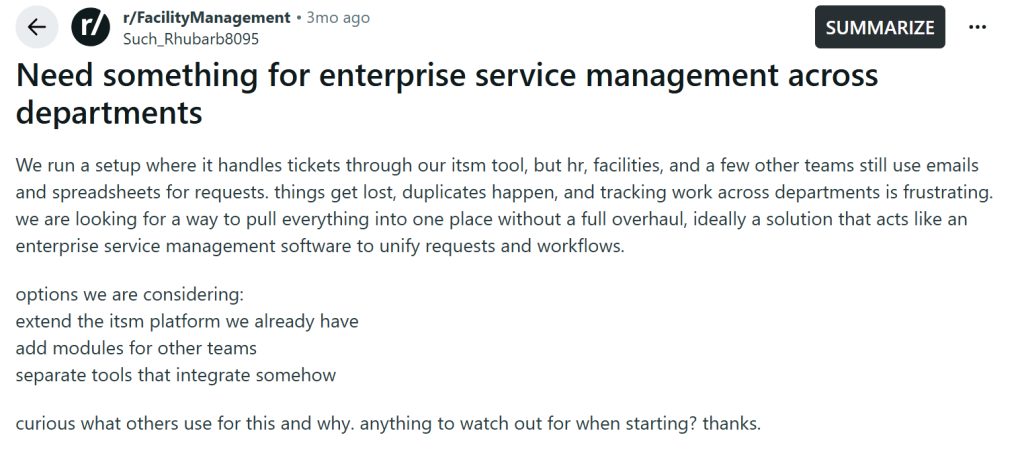
Source: Reddit
The answer / advice from people who’ve been there:
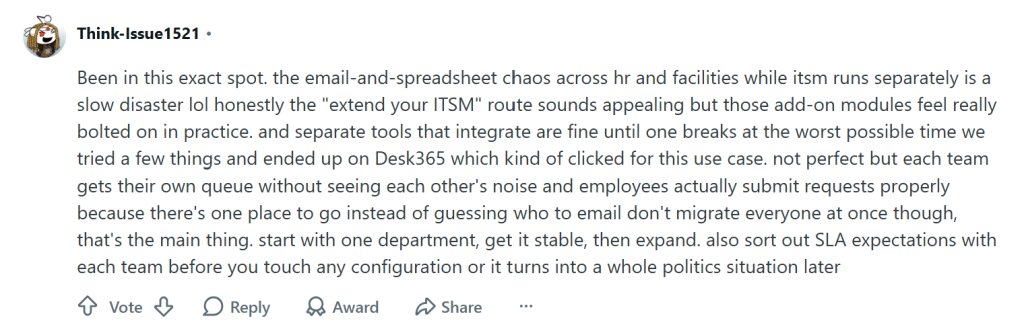
Some key lessons from this approach:
- Start small. Don’t migrate everyone at once. Pick one department, get their workflows stable, then expand.
- Set SLA expectations upfront. Before touching any configuration, make sure each team agrees on service levels, or it turns into a politics mess.
- Focus on the low-hanging fruit first. Automate the high-volume, low-complexity requests to get early wins and show leadership the value.
- Build a unified service catalog. Every department should define what services they provide, the SLA, and how requests are submitted. IT probably has this figured out, but HR, Finance, Facilities, Legal often don’t.
- One employee-facing portal. Employees shouldn’t need to know which system to use. One front door, with routing logic handled behind the scenes.
- Make metrics visible. Track request volume, resolution times, SLA adherence, and share this with department heads. When everyone sees how services are performing, accountability naturally follows.
Why CIOs need to own this
There is a governance question at the center of ESM that often goes unaddressed: who leads it?
In most organizations, no one does. Shared services initiatives get started and then stall because they lack a clear owner with cross-functional authority. HR does not want to be dependent on IT. Finance does not want to restructure workflows around someone else’s tooling.
CIOs are uniquely positioned to break that deadlock. You have the platform expertise, the vendor relationships, the understanding of integration complexity, and increasingly the organizational mandate to drive digital transformation beyond your own function. Employee experience is now a CIO priority, tied directly to productivity, revenue, culture, and talent outcomes. It is not an HR project with IT support. It requires IT leadership to work.
The Forrester Wave for Enterprise Service Management Platforms, published in Q4 2025, described ESM as the operating system of the service economy. That framing captures the stakes. Nearly every function now operates as a service provider. When those service delivery mechanisms are fragmented, unmeasured, and misaligned, the cost shows up in employee productivity, onboarding quality, and operational resilience, and none of those costs appear as a line item in the IT budget.
The question for CIOs in 2026 is not whether to build an enterprise service management capability. It is how quickly you can do it before someone else in the organization tries to do it without you.
Frequently asked questions
Many organizations run IT requests through an ITSM tool, but other teams like HR, Finance, and Facilities still use emails and spreadsheets. This often leads to lost requests, duplicates, and difficulty tracking work. The best approach is to create a unified service catalog for all departments, build a single employee-facing portal for submitting requests, and automate the high-volume, low-complexity tasks first. Start small with one department, define SLAs, establish cross-department governance, and make metrics visible to ensure accountability. Over time, this approach brings all services into one manageable system without requiring a full platform overhaul.
Track metrics such as:
- Request volume by department
- Average resolution time
- SLA compliance
- Backlog trends
- Employee satisfaction
Sharing these metrics across teams drives accountability and helps identify areas for improvement.
Begin with a unified service catalog for every department – IT, HR, Finance, Legal, Facilities, etc. List what services are offered, the expected SLA, and how employees can request them. Build this before automating anything. Then, create a single employee-facing portal so staff have one front door to submit requests. Routing and workflows should happen behind the interface, not in the employee experience