
Humans of Support is our interview series featuring the people building and running customer support teams. Each episode brings a different perspective from the industry.
Every conversation runs in two parts. First, questions built around that guest’s specific expertise and experience. Then, a set of rapid-fire questions we ask every guest to get a good picture of the industry landscape.
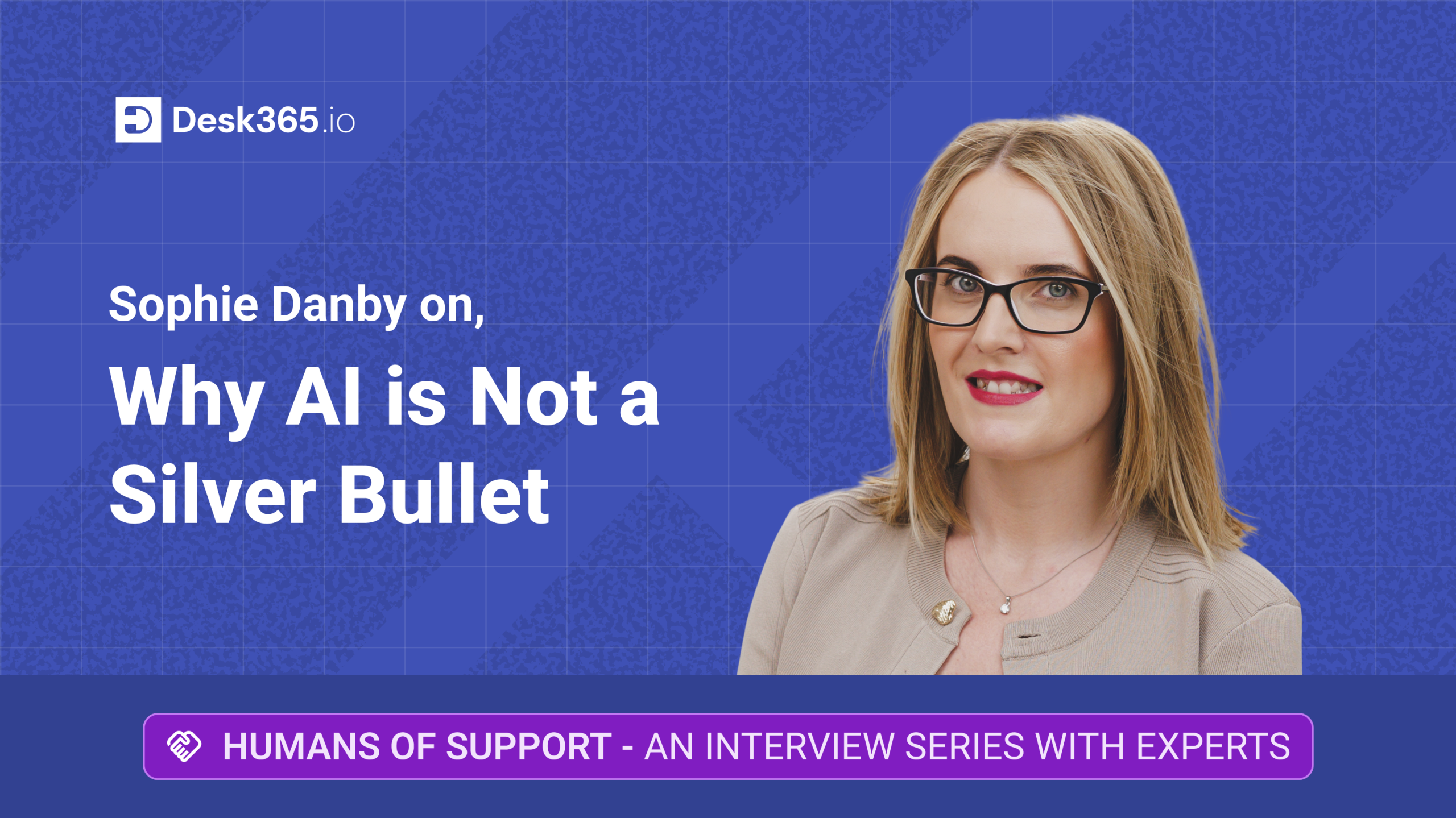
For this episode, we’re talking to Sophie Danby, ITSM & ITAM Marketing Consultant and Co-owner of ITSM.tools, where she shapes thought leadership content and writes on service management, ITIL, and the industry’s constant chase with new technology. Sophie has spent over a decade watching ITSM cycle through its trends from a front-row seat.
In this rapid-fire round, we put a set of quick questions to Sophie covering everything from overrated metrics to buzzword fatigue. Her answers touch on why the industry keeps getting distracted by new technology, why AI is being oversold, and why “agentic” needs to be retired for good.
Here’s the full interview with Sophie Danby below.
You've spent years building ITSM.tools into one of the industry's go-to publications. What have you learned about the ITSM community that surprised you the most?

What surprises me most is how easily the industry gets distracted by “the new shiny thing” (as Paul Wilkinson would say) year after year.
Sophie Danby, ITSM & ITAM Marketing Consultant
Every year, there’s something new, usually a piece of technology, and every year, a chunk of the industry drops what it’s doing to go play with it. Then every year, the same people act surprised when it doesn’t turn out to be the silver bullet that fixes everything. I keep hoping the tide will turn, and then I look at people like Barclay Rae and Mark Smalley, as well as Paul, who’ve watched this same pattern repeat for thirty years, and then I don’t feel quite as optimistic.
Because you speak with vendors, practitioners, and consultants every week, what conversations are happening behind the scenes that the rest of the industry isn't paying enough attention to?
It isn’t a behind-the-scenes conversation at all; everyone who knows the industry well is talking about it. Nobody focuses on people enough. Everyone pours their energy into product and technology, or, at a stretch, process, and almost nobody puts the same effort into people, who are ultimately the make-or-break factor in whether any of it works.
"I'm going to start feeling like a Paul Wilkinson quote machine, but he's right: we must focus on attitude, behavior, and culture. Get the people side wrong, and no amount of shiny technology or fancy processes will save you."
What's one trend you think people are overestimating, and one they aren't talking about enough?
People are overestimating how far AI will take them. The industry is already feeling the effects of teams rushing AI in without thinking it through, without the basics, the good data, and the governance in place underneath it. AI is not a silver bullet, and it never will be, however impressive the technology gets. It only works if the layer beneath it is solid, and for a lot of organizations that layer is a mess. Sort that out first; otherwise, the clever tool on top just fails faster and costs you more.
If someone new joined the ITSM industry tomorrow, what advice would you give them to build credibility and avoid getting lost in the noise?
Go to conferences. So much happens online now, meetings, virtual events, the lot, and none of it beats being face-to-face with people. Get to know others in similar roles, seek out the people who’ve been doing this for a long time, and make the time to sit in on the presentations. The relationships that really help you advance get built in person.
What's one ITSM metric that gets far more attention than it deserves?
MTTR, mean time to resolve. It measures speed, and speed alone tells you little about the service people received.
It’s an average, so it hides what’s really going on; a team that closes most tickets fast but leaves a handful of people stuck for days can show the same figure as one that gives everyone a mediocre experience. It’s easy to game too: close early, split tickets, move the hard ones out of the queue, and the number improves while the service is no better. It just incentivizes teams to close tickets quickly rather than ensuring the issue is properly resolved.
Do organizations have too many tools, or are they not getting enough out of what they already have?
Yes, without a doubt. In fact, Barclay Rae recently wrote a really good piece on why you probably don’t need a new ITSM tool that’s worth a read. Organizations end up on their third or fourth tool in a decade, each time sure this one will finally sort everything out, and within about eighteen months, the same frustrations are back.
"A new tool doesn't fix bad data, unclear service definitions, or a culture that doesn't value service management; it just moves all of that onto a shinier platform."
Most tools do broadly the same core things anyway, so the answer far more often is getting proper value out of what you already own, before you spend a fortune and a year of everyone’s energy on a migration that leaves you right back where you started.
What's one practice every IT team talks about, but very few actually do well?
Organizational change management. Every transformation, every tool rollout, every new way of working depends on it, and almost nobody does it properly. Teams will spend months on the technology and the process, then treat the people side as an afterthought, a couple of emails and a training session bolted on at the end. Most failed initiatives don’t fail because of the technology; they fail because the people side was missed.
If you were advising a support team on how to talk about their AI features without sounding like everyone else, what would you tell them?
Stop selling the features and functions of the technology. Talk instead about the business challenges it solves, the value people can create when they use it properly, and the part people themselves play in getting there. Buyers care about their problems, not your feature list. Show them you understand the problem and can help them fix it, and be straight with them that the technology only delivers if the people around it are set up to use it well.
Do you think customers/end-users actually care that a bot answered them quickly, or do they just want the problem solved?
Getting the issue solved, every time. Only last week I spent ten minutes going round in circles with an AI bot on a B2C website, practically begging it for a human, and the moment I reached that human, I had my fix in about thirty seconds. Bots can be helpful, and it’s a tricky balance, because when you’re frustrated, you want help right now. But if the instant help gets you nowhere, you have to wonder whether waiting for a human would have been the better deal all along.
AI: boon or bane for a business built on human touch and live, 24/7 reps?
Both, depending entirely on why you bring it in. Point it at the repetitive, draining volume so your reps get that off their plate and spend their time on the conversations that need a person, and it’s a real help. Bring it in purely to cut headcount, and service quality drops.
"Whether it helps or hurts has nothing to do with the technology and everything to do with why you brought it in and how you use it."
Do you think a human on the phone will still matter in five years, no matter how good AI gets?
Yes. Plenty of the routine stuff will go to automation, and rightly so; nobody enjoys sitting in a queue to ask something a machine could answer in seconds. But when a problem is high-stakes, complicated, upsetting, or just badly broken, people want a competent human who can pick it up and look after them. The better AI gets at the simple cases, the more the calls that reach a person are the difficult ones, and that’s the last place you’d want to hand someone a bot.
From 2006 to 2016 to 2026, how have you seen support change?
2006 was heavy process, on-premises tools, and support seen as a cost to be controlled. By 2016, we’d moved to cloud and SaaS, and self-service and shift-left were the buzz, with service management spreading more visibly beyond IT into the rest of the business. 2026 is the AI year: every vendor is selling it, some of the automation is doing useful work, but plenty of teams have rushed it in without the data or the groundwork to make it pay off. And across all twenty years, the same blind spot: the people side never getting the attention it needs.
If you could change one thing about how companies think about support, what would it be?
That cutting headcount is the way forward. It’s the reflex every time budgets tighten. You strip out the people who hold the knowledge and keep the whole thing running, then act baffled when service quality falls off a cliff and whoever’s left burns out covering the gap.
"Support is one of the few functions that touches every person in the business, every week. Cut it back to save money, and the damage hits everywhere, because support is where every end-user and customer forms their view of IT."
Describe great support in one sentence
Ideally, you never need support at all, because things are set up well enough that nothing goes wrong in the first place. Good support is what catches the issues that slip through, sorting them quickly so you lose barely any time getting back to work.
One ITSM buzzword you'd retire immediately.
Agentic. I'm sick of reading the same marketing slant on it over and over.
The word’s been slapped on so much that it now tells you nothing about what a product does, only that the vendor’s chasing the current trend in the hope of more sales.