
Humans of Support is our interview series featuring the people building and running customer support teams. We speak to people who’ve lived through endless escalations and multiple waves of technology change.
In an AI-first era, human expertise and the perspective of veterans that have been there done that help elevate, validate, and enrich support strategy.
If you’re an agent, a leader, or anyone learning and growing in support right now, each episode of this series brings human wisdom that complements the AI-support playbook.
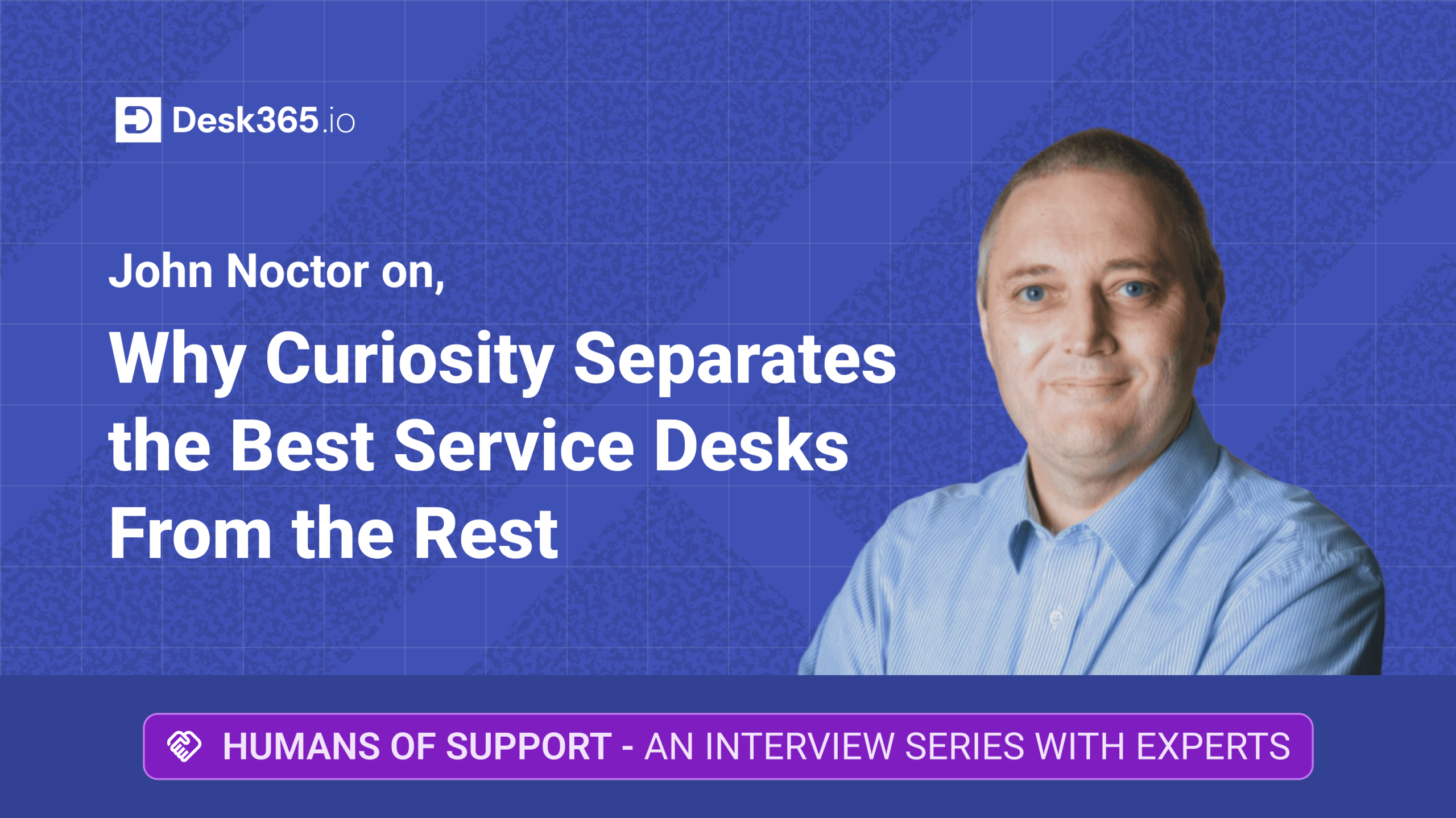
For this episode, we’re talking to John Noctor, Chief Customer Success Officer at the Service Desk Institute (SDI), where his role spans everything from owning the SDI’s Service Desk certification program to leading audits, workshops, training and consultancy, judging the SDI’s global awards, and shaping the direction and innovation the SDI brings to the industry.
John has spent decades inside organizations at every stage of ITSM maturity, and that vantage point shapes almost everything he has to say: that the teams who keep improving are the ones who stay curious about their own numbers, that a ticket can be SLA-green while the customer is still seeing red, and that AI is only a boon if the business case is about freeing humans up rather than replacing them.
Here’s the full interview with John Noctor below.
Through your work at SDI, you've seen organizations at very different stages of ITSM maturity. What's one characteristic that consistently separates the teams that keep improving from those that plateau?

Mature organizations don't use best practice as a destination. They use it as a platform for asking what's next.
John Noctor, Chief Customer Success Officer, Service Desk Institute
Curiosity. The best performing teams don’t just fix tickets, they ask why customers are contacting them, what’s creating effort, how they could prevent it, and what’s changed in the business that’s driving ticket volume or ticket type. Teams that plateau tend to fall into business as usual, where continuous improvement becomes an annual initiative instead of part of how they think and work every day.
Linked to that is psychological safety: empowering teams and setting an environment where people can challenge the status quo with respect and say what isn’t working.
You've said customer success is about outcomes, not just satisfaction. Why should organizations measure something beyond SLAs and CSAT to know if they're genuinely delivering better service?
A ticket can be SLA-green while the customer is still seeing red.
Customer experience is a moment in time, the experience a customer has when they contact you. Success elevates that into understanding what they’re actually trying to achieve. Operational metrics are an essential foundation, but if the focus is purely operational, you’ll miss the outcomes.
That’s where experience management comes in: customer effort, time to productivity, reopen rates, first contact resolution, digital experience, and critically, customer sentiment. There’s a huge amount of knowledge in the interactions teams have with customers, and the challenge is using technology to actually analyze that data and understand what people were feeling.
There’s a concept in the industry called the watermelon SLA: a report that looks green from the outside, but is red once you cut into it. That’s where sentiment becomes so powerful.
What's one challenge that almost every IT support team is dealing with today, regardless of size?
The customer is never wrong, but they're not always right either.
Managing customer expectations that are rising almost exponentially alongside the complexity of the technical world: SaaS, cloud, hybrid, AI, automation, mobile, collaboration, all of it. But customers don’t care about the complexity you’re managing behind the scenes. They just want to carry out their business processes.
Think of a stage curtain: everything behind it can be complex, but in front, people want something simple, easy to understand, and even enjoyable. AI is helping with that complexity. Understanding that expectations aren’t always fair, but aren’t always wrong either, is part of understanding friction.
You've been in the industry across three decades, 2006, 2016, 2026. How has support changed at its core?
Understanding the why, not just the what, is the secret sauce of service management.
Honestly, I don’t think it has changed at its core. In 2006 we were resolving incidents, fulfilling requests, managing changes, looking for patterns, the same things we do now. What’s changed is the technology layered on top to enable those outcomes, and for good reason.
What’s really shifted is the understanding that we’re not just fixing technology, we’re supporting people and enabling outcomes. Ironically, the more technology we put into support, the more important human moments become. It’s not just about speed anymore, it’s about taking people with you on a journey, however short that journey is.
We’ve got to remember why people contact the service desk in the first place: something has happened, or needs to happen, that’s stopping them from carrying out their business process.
AI: Boon or Bane?
If an AI business case starts and finishes with how many people we can remove, we've missed a huge opportunity.
Absolutely a boon, but only if we remember what we’re actually trying to do with it. It becomes a bane if we rush into adoption without a clear understanding of what problem we’re solving, and especially if the business case starts and finishes with headcount reduction.
AI should remove the work humans don’t need to do, so people have more time for what they’re uniquely good at: empathy, judgment, ambiguity, relationship building. I like the analogy that AI will become like electricity, so ingrained in how we work that we stop noticing it’s there, even though nothing runs without it.
Done well, AI doesn’t make services less human, it gives humans more time to be human. That’s about human-AI interoperability, not replacement.
Do you think there'll ever be a point where humans are completely replaceable in support, especially at the first line?
The greatest organizations won't pursue replacement without planning.
A lot of simple, and even fairly complex, interactions will be enabled much better by AI, but this isn’t about reducing headcount. It’s about better use of the headcount you have, freeing people from the things that don’t add value so they can deliver better experiences.
Five years ago we wouldn’t have even been having this conversation about AI, and look how far it’s come. I think it’s almost impossible to see 10, 20, 30 years out, but in the next five to ten years, we will see parts of roles change. The organizations that get the most out of AI will be the ones that understand human-AI interoperability.
What's one ITSM trend today that's genuinely underrated and that everyone should adopt?
Don't just think of digital friction as the big things, sweat the small stuff too, because it's what determines how smooth the overall experience feels.
We’ve concentrated too much on digital transformation. It drives innovation, but if that’s the only focus, we’re missing something vital: digital enablement, and reducing digital friction.
It’s about understanding how digital products and services enable the core business to succeed, and then removing the friction in the way, whether that’s exacerbated by the digital world we’re building or introduced by it. Friction can be as simple as multiple logons, too many fields on a form, or bad design. It sounds small, but it compounds.
I joined this interview today and found my mic had been automatically muted, every other meeting I join, it isn’t. That’s 30 seconds of friction right at the start of a conversation. It sounds trivial, but that’s exactly the point.
If you had to sum up what good support looks like today?
Treat a human like a human.
Understand why they’re contacting you, not just what they need. Measure the sentiment behind the ticket, not just the SLA around it. And remember that no matter how much technology you layer on top, the core of support, enabling people to get on with what they were trying to do, hasn’t changed at all.