
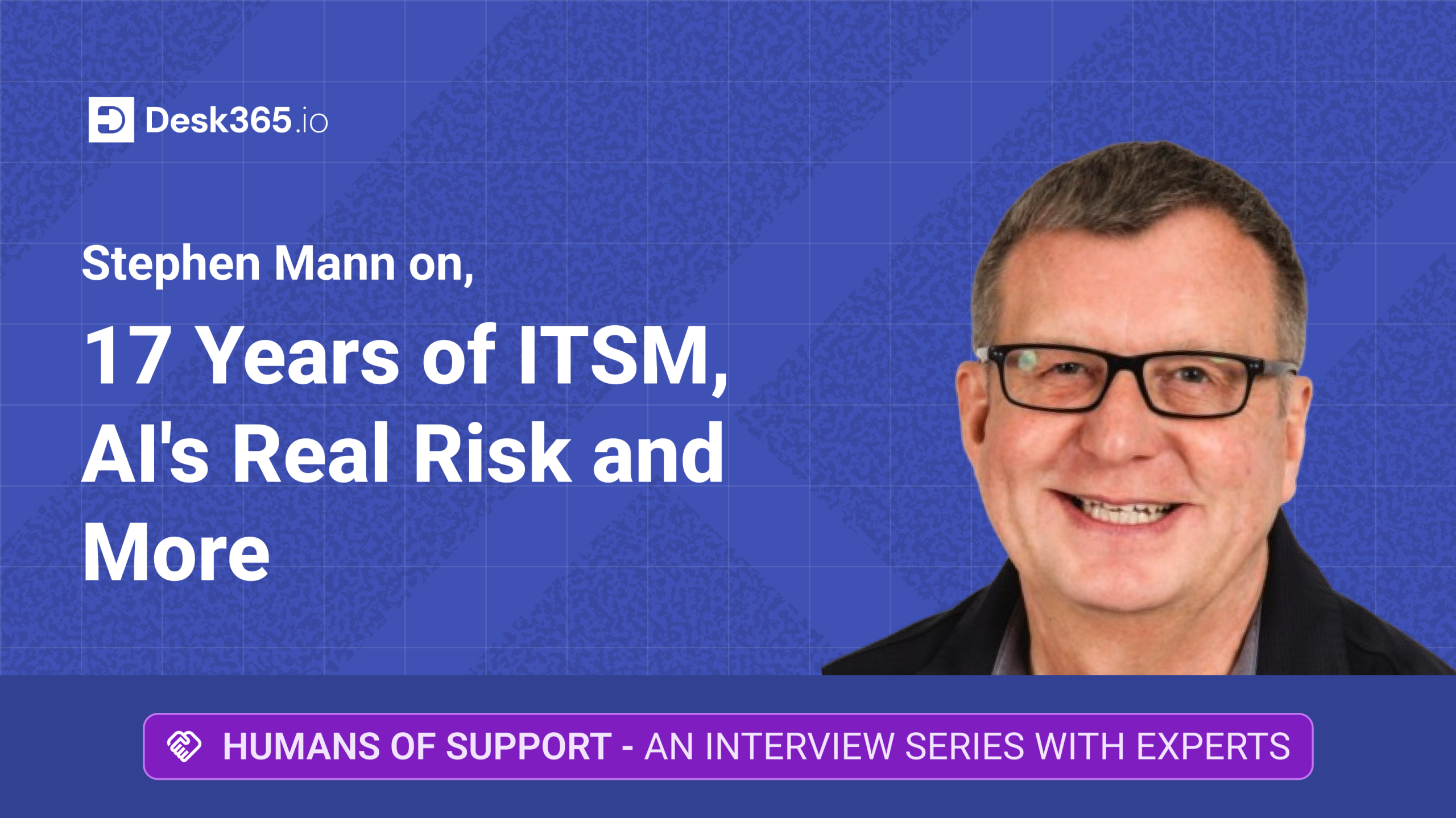
Today we’re kicking off Humans of Support, a new interview series featuring the people building and running IT support. Each episode brings a different perspective from the support industry.
Every conversation runs in two parts. First, questions built around that guest’s specific expertise and experience. Then, a set of rapid-fire questions we ask every guest to get a good picture of the industry landscape.
We’re opening the series with Stephen Mann, Industry Analyst and Content Director at ITSM.tools. Stephen has been writing about IT service management since 2008 and has seen the industry from both sides of the table, with time on the vendor side as well as the enterprise side, including stints at analyst firms like Forrester.
In this first conversation, we asked Stephen what’s genuinely changed in ITSM since 2008, why vendors and buyers keep talking past each other, why most RFPs end up asking the wrong questions, what’s real versus what’s hype in AI right now, and the one buzzword he’d like to see retired from IT for good.
Read on for the full interview. And remember to bookmark the blog, because this is just the first of many conversations to come.
Here’s the full interview with Stephen Mann below.
You've been writing about ITSM since 2008. What's changed the most about how organisations think about service desk and support — and what's stayed exactly the same?
Enterprise service management showed up around 2008, employee experience followed from 2015 onward, and COVID pushed a lot of organisations toward SaaS delivery, a shift they’d been putting off for years. Then came 2023, and ChatGPT.

"IT service management has traditionally been a slow tanker to turn, whereas with AI, since 2023, things have changed so rapidly."
Stephen Mann, ITSM Content Specialist & Industry Analyst, ITSM Tools.
The one thing that hasn’t changed is value. It’s been with us for at least 15 years, some would argue longer, and we still really struggle with it from an ITSM perspective. Even ITIL 4’s 2019 shift toward the co-creation of value hasn’t fully landed inside most IT organisations.
You've been on both sides of the coin, vendor and enterprise. What's the biggest disconnect you still see between how vendors pitch ITSM tools and what buyers actually need?
Both sides still tend to sell and buy on functions and features instead of value, and that’s how you end up with a 500-line RFP. Stephen quoted Ivor Macfarlane on this:
"If you ask the wrong questions, you get the wrong answers."
Customer organisations need solutions, but they’re often still focused on products, and vendors are often still trying to sell products rather than solutions. You can hand a customer everything they asked for in their RFP and still not have given them as much real help as you could have.
What makes a piece of vendor content actually worth an IT practitioner's time to read?
"People are now publishing content that took less time to write than it takes people to read it, which is quite scary, really."
That’s not an argument against AI-assisted content, though. If vendors are going to use AI to create content, I have no problem with that, but it needs subject-matter-expert review to make sure everything checks out. Skip that step and it ends up full of errors that only someone who knows the subject would catch.
What is an ITSM trend today that you think is genuinely underrated?
Experience management. It’s not that nobody talks about it, people already bring up XLAs instead of SLAs all the time. The real gap is buy-in, and that comes back to understanding why IT service management and the service desk exist in the first place: to enable people, business operations, and outcomes.
Value is the tougher nut to crack. It’s hard to understand how what we do, or don’t do, in IT impacts the business, because every organisation is a business.
You help enterprises build RFPs when choosing ITSM tools. What's the most common mistake you see organisations make?
Two mistakes stand out. The first hasn’t changed in 20 years, only the method has. Someone used to Google “ITSM tool RFP,” pick up a template, add a few things, and send it out. These days they’ll probably ask ChatGPT, Claude, or Gemini to create it instead. The problem is the same either way: either route produces a list of things typically found in an ITSM tool, not a list of things that matter to that organisation.
The second mistake is newer: the “decision-based RFP,” where someone picks the tool first, then reverse-engineers the requirements to fit it. My fix, borrowed from ITSM consultant Stuart Rance, is to workshop the list down to 10 to 20 outcome-focused must-haves instead of a feature checklist.
If you were advising a mid-sized IT team choosing between multiple help desks, what would you tell them to prioritise?
You need to recognise that you’re not buying an IT help desk tool for IT’s sake, you’re ultimately buying it as a business application.
When two products look nearly identical, it’s that old adage, but the other way round: it’s not “it’s not you, it’s me,” it’s “it’s not me, it’s you.” Forget the agent’s inbox for a second and ask what the rest of the business needs from the tool instead.
What questions do buyers forget to ask that they really should?
Buyers need to go beyond asking what’s available. They need to get into the detail: how do we actually use this? How do we benefit from it? How do we govern it responsibly? Don’t chase every AI feature a vendor lists, most ITSM tools look similar on paper now. Focus on what sets your organisation apart.
What's the one thing you wish more vendors understood about AI hype versus AI reality in ITSM?
You can give a customer every AI capability in the world, but if they can’t get it to work in their organisation, they’re not going to realise the benefit you promised when you sold it to them. Vendors selling capability alone are selling half a solution.
It’s a great opportunity, but also a great risk, if organisations don’t do it in a way that causes more harm than help. We made the same mistake with early self-service: companies built the technology without thinking about how it would affect people, then wondered why nobody used it.
"AI risks repeating that, just faster and with more at stake."
AI is learning faster than ever. Five years from now, with AI getting as good as it gets, will a human on the phone still matter?
No matter how good AI gets, there’ll still be gaps. I asked ChatGPT about ITIL and it told me version 4 was current, when the industry had already moved to ITIL 5. Harmless for an expert who catches the mistake. Not so harmless for someone who doesn’t.
"There'll be far fewer people in support, but they'll be there for escalation, more than anything else."
2006, 2016, 2026, almost three decades. How has support at its core changed?
It would be wrong not to call out AI, because we’ve seen nothing like it in IT service management. Enterprise service management took from 2008 to the 2020 pandemic before it really took off, that’s how slow this industry usually moves.
But I’m wary of treating AI as a fix for everything, especially around process mapping. The assumption now might be that AI can just do that for us, when actually it’s the reverse: AI needs the process maps to understand the context it needs to do its job properly.
If you could change one thing about how companies think about IT support, what would it be? And if you had to describe great support in one sentence?
"I've said for a long time that IT support should be called people support."
It’s about enabling people, business operations, and business outcomes.
One ITSM buzzword you'd retire immediately?
"Deflection. The word itself means 'go away.'"
The intention behind self-service and AI-first support isn’t wrong, it’s the language that’s broken. If you had a 65% deflection target in IT, and you told an end user “we’re looking to deflect 65% of your requests for help,” I think they’d be mortified.
What would you tell someone just starting out in IT?
Working in ITSM isn’t about closing tickets. It’s about helping people, and helping the organisation be more competitive and more successful.
"If you can't find a way to add value beyond the ticket queue, your role will shrink, and eventually disappear."
If you can, IT stays one of the fastest ways to help people do things they couldn’t otherwise do for themselves.



 AI Agent
 Asset Management
 Knowledge Base
 Automations
 SLAs
SLAs
 Customization
 Ticket Assignment
 Reports & Analytics
 Approval Management
 Helpdesk Security
 Explore All Features
 Banking and Finance
 Healthcare
 MSP
MSP Government
  Non Profit
 IT Services
 Customer Support
 Human Resources
 Facilities