

Imagine this: A customer in Brazil places an order and reaches out with a question in Portuguese. They get a reply in English. They switch to a translator, retype their message, and wait longer than expected. The issue gets solved, but the experience feels harder than it should.
Another customer browses your store using auto-translation, completes a purchase, then receives a follow-up email in English. They don’t fully understand it and miss important details.
On the other side, your support team is copying messages into translators, guessing context, and replying back with crossed fingers.
It works, but not smoothly.
And when this happens across dozens or hundreds of conversations, it starts to cost time, clarity, and even revenue.
That’s why multilingual customer support is important.
What is multilingual customer support?
Multilingual customer support means helping customers in more than one language, so they can understand and communicate without confusion.
Instead of forcing everyone to use a single language, businesses give customers the option to read, ask questions, and solve problems in a language they are comfortable with. This can happen through chat, email, phone calls, or even inside apps and websites.
A simple way to understand this is by looking at how Airbnb handles communication. It uses automatic translation so users can read listings and reviews in their own language. At the same time, it also has support agents who speak different languages. This helps when customers have specific or detailed questions that need human interaction.
Another good example is Netflix. It offers subtitles, dubbing, and localized content so users can enjoy shows in their preferred language. Beyond content, it also makes its platform and support experience easier for global users by adapting language across the entire journey.
The idea is simple. When people can communicate in a language they understand well, they feel more confident and satisfied. Multilingual customer support helps businesses connect better with users and create a smoother experience for everyone.

Source: Airbnb
Benefits of multilingual customer support
Builds trust with customers
When customers can communicate in a language they are comfortable with, it creates a sense of ease right from the start. They do not have to struggle to explain their problems or worry about being misunderstood. This clarity helps build trust over time, as customers feel the brand genuinely understands their needs and values their experience.
Improves customer satisfaction
A smooth conversation leads to a better experience. When customers receive support in their own language, they are more likely to feel satisfied with the interaction. Studies show that around 70% of users feel more loyal to companies that offer support in their native language. This means language is not just about communication, it directly affects how customers feel about your service.
Increases conversions and sales
Language plays a key role in decision-making. Customers are more confident buying a product when they fully understand the details, policies, and benefits. Research by CSA shows that 76% of online shoppers prefer buying products with information in their own language, and about 40% will avoid purchasing if it is not available. This clearly shows how multilingual support can impact revenue.
Reduces support delays and confusion
Miscommunication often leads to longer resolution times. When customers and support teams do not share a common language, simple issues can become complicated. Multilingual support removes this barrier by allowing clear and direct communication. This helps teams resolve queries faster and improves overall efficiency.
Gives a global competitive advantage
Businesses that offer support in multiple languages can reach and serve a wider audience. Customers are more likely to choose brands that make communication easy. In fact, around 35% of users say they would consider switching to another product if it offered support in their language. This makes multilingual support a strong advantage in competitive markets.
Creates a better overall experience
Language affects every step of the customer journey, from exploring a product to getting post purchase help. When everything is easy to understand, customers feel more comfortable and confident. This leads to higher retention, better reviews, and stronger word of mouth.
In simple terms, multilingual customer support helps businesses connect more naturally with customers, improve service quality, and grow across different regions without language becoming a barrier.
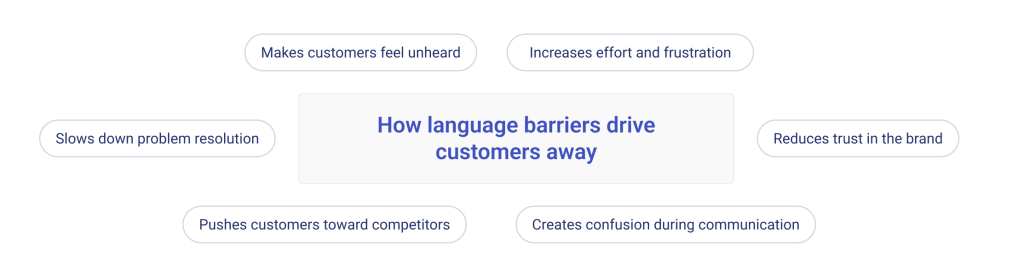
How language barriers drive customers away
Creates confusion during communication
When customers cannot fully understand what is being said, even simple interactions become difficult. They may misinterpret instructions, policies, or responses. This confusion often leads to frustration and makes the whole experience feel stressful instead of helpful.
For example, a customer trying to return a product might misunderstand the return policy because it is not in their language. They could miss important steps and end up with a rejected request.
Makes customers feel unheard
If a customer struggles to explain their problem clearly, they may feel like the company does not understand them. This creates a sense of disconnect. Even if the support team is trying to help, the lack of clear communication makes customers feel ignored or misunderstood.
Increases effort and frustration
Customers do not want to put extra effort just to get basic support. If they have to translate messages, rephrase sentences, or guess meanings, it becomes tiring. Over time, this frustration pushes them to look for easier alternatives.
For example, a customer using an app in a foreign language might have to copy and paste text into a translator just to understand basic features. This extra effort can quickly become annoying.
Reduces trust in the brand
Clear communication builds confidence. When language becomes a barrier, customers start doubting whether the company can actually solve their problems. This uncertainty reduces trust and makes them less likely to continue using the service.
For example, if a customer receives unclear or poorly translated responses from support, they may feel the company is not reliable or professional.
Slows down problem resolution
When there is a language gap, resolving issues takes longer. Back and forth communication increases, and errors are more likely. Customers who are already facing a problem may lose patience if it takes too long to get a clear answer.
For example, a simple delivery issue that could be solved in one conversation may take multiple messages because both sides are trying to understand each other.
Pushes customers toward competitors
If another brand offers support in a language the customer understands, switching becomes an easy decision. Customers naturally choose the option that feels simpler and more comfortable.
For example, if two similar services are available but only one offers support in the customer’s language, the customer is more likely to choose the one that feels easier to use.
A CSA Research study highlights this clearly. Around 40% of customers will not buy in a language other than their own, and 65% prefer content in their native language, even if it is of lower quality. This shows that language matters more than perfection when it comes to customer experience.
Strategies to implement multilingual customer support
Identify your key customer languages
Start by finding out which languages your customers actually use. You do not need to support every language from day one. Check website traffic, customer locations, support tickets, app usage, and sales data to understand where demand is coming from.
For example, if a large number of customers are visiting your website from Spain, France, and Germany, it makes sense to first offer support in Spanish, French, and German instead of trying to cover ten languages at once.
This matters because language affects buying decisions. Research found that 76% of online shoppers prefer buying products with information in their own language, and 40% will not buy from websites in other languages
Use both technology and human support
Technology can help you scale faster, but it should not fully replace people. Machine translation, chatbots, and translated FAQs are useful for simple questions. But for complex issues, human support is still important.
For example, a chatbot can help a customer track an order or reset a password. But if the customer has a billing dispute, refund issue, or emotional complaint, a human agent who understands the language and tone can handle it better.
This is similar to how Netflix uses subtitles, dubbing, and localization to make content easier for global users. It is not just about translating words, but making the experience feel natural.
Hire or train multilingual support agents
A strong multilingual support team needs people who can speak and understand different languages clearly. These agents can help customers explain problems without depending only on translation tools.
For example, if a customer is upset about a delayed delivery, a multilingual agent can understand the issue, respond with empathy, and solve it faster. A direct human conversation often feels more personal than a translated message.
Intercom found that 70% of users feel more loyal to companies that provide support in their native language. It also found that 29% of businesses lost customers because they did not offer multilingual support.
Localize your support content
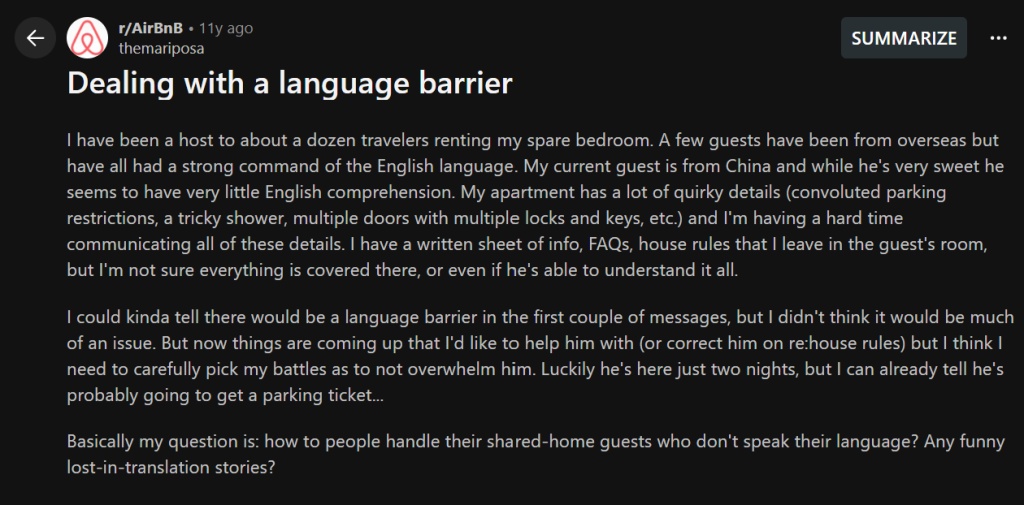
Source: Reddit
The Reddit thread shows a common language barrier problem. The Airbnb host had written instructions, FAQs, and house rules, but still wasn’t sure whether the guest understood important details like parking rules, door locks, and apartment instructions.
This is where localization matters.
Translation changes words from one language to another. Localization makes the message clear, natural, and useful for the person reading it. For example, house rules, return policies, delivery updates, or billing instructions should not just be translated word-for-word. They should also use local terms, simple explanations, and context that the customer can easily understand.
That’s why multilingual support should focus on clarity, not just translation.
Offer multilingual self service options
Many customers do not want to contact support for every small issue. They prefer solving problems on their own if the information is easy to understand. That is why businesses should create help centers, FAQs, guides, and chatbot flows in multiple languages.
For example, a customer who wants to cancel a subscription should be able to find clear steps in their preferred language. If they cannot understand the help article, they may contact support or leave the platform completely.
Add an easy language selection option
Customers should not struggle to find their preferred language. Add a clear language selector on your website, app, chatbot, and help center.
For example, if a user lands on your support page, they should be able to switch languages in one click. This small feature makes the experience smoother and reduces confusion from the beginning.

Keep support consistent across all channels
Multilingual support should not be limited to only one channel. If customers can get help in their language on chat but not through email or phone, the experience feels incomplete.
For example, a customer may start with live chat, then move to email for a detailed issue. If the language support disappears midway, they may feel frustrated and unsupported.
Use customer feedback to improve
Multilingual support is not a one-time setup. Businesses should keep checking customer feedback, ticket quality, translation accuracy, and response times.
For example, if many customers complain that translated help articles are confusing, the content should be reviewed and improved. If one language has slow response times, the company may need more agents for that region.
Desk365 reports that 73% of consumers will switch to a competitor after multiple bad experiences, which shows why improving support quality matters.
Making customer support more accessible across languages
Great customer support should feel easy, no matter what language a customer speaks. When people can explain their problems clearly and understand the answer without relying on guesswork, they are more likely to feel confident in your brand.
Multilingual customer support helps remove friction from the customer journey. It makes conversations smoother, reduces repeated explanations, and helps support teams solve issues with more accuracy. More importantly, it shows customers that your business is making an effort to meet them where they are.
You do not have to support every language from day one. Start by looking at where your customers are coming from, which languages appear most often in tickets, and where communication gaps are causing delays. From there, you can add translated help articles, multilingual chat options, localized templates, or support tools that make language management easier.
In the end, multilingual support is about more than communication. It is about creating a support experience that feels personal, respectful, and accessible to every customer you serve.
See how they do it.
Frequently asked questions
Multilingual customer support means helping customers in more than one language through channels like email, live chat, phone, help desk portals, chatbots, and knowledge base articles.
Translation changes words from one language to another. Multilingual support is broader. It includes translated content, localized communication, multilingual agents, language settings, support workflows, and culturally clear responses.
Not always. Native-speaking agents are helpful for complex or sensitive issues, but businesses can also use translation tools, multilingual help centers, chatbots, and localized templates to automatically respond in the local language common support questions.