
Support and IT service management have changed significantly over the years, but the fundamentals remain surprisingly familiar. Technology has become more complex, customer expectations have evolved, and AI is changing how teams work. Yet, at its core, support is still about helping people overcome problems that stop them from getting things done.
Humans of Support is our interview series where we put the spotlight on the people who have been there and done that in the world of support and IT service management. Through these conversations, we bring real human expertise to IT practitioners navigating a rapidly changing industry.
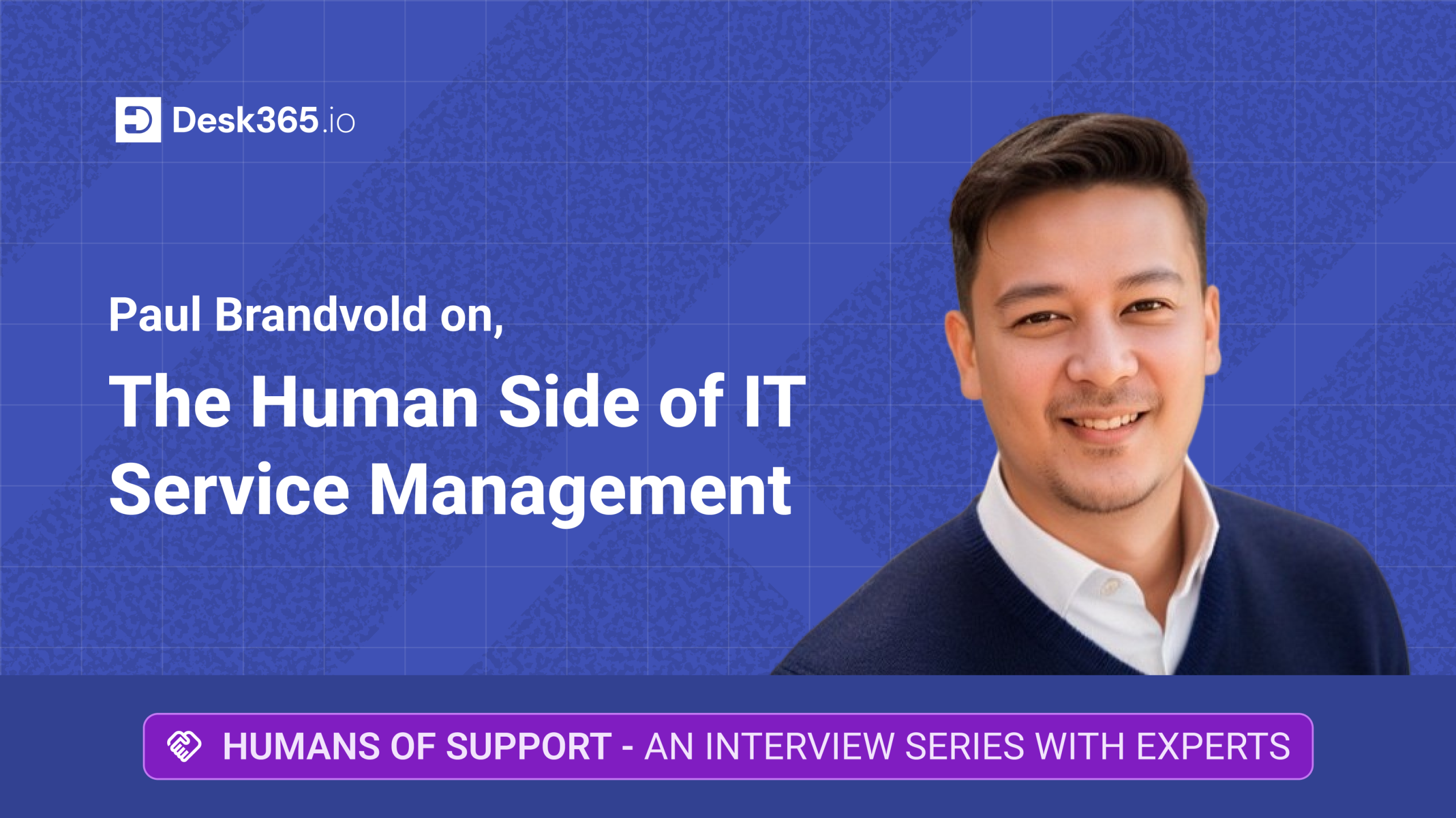
In Episode 7, we speak to Paul Brandvold, an ITSM leader, ITIL Master, adviser, speaker, and author of The Human Side of IT Service Management. With more than 15 years of experience across South Asia and Europe, Paul shares his perspective on cultural differences, proactive support, service metrics, responsible AI, and the ITSM trends that deserve more attention.
Having worked across different countries and cultures, how have you seen cultural differences influence the way organizations approach ITSM and customer experience?

It’s extremely important to have people who challenge the way we work so we can improve
Paul Brandvold, ITSM leader, ITIL master, and advisor
I think one of the main areas I would touch on is how leaders need to treat things differently because of cultural differences.
For example, in the Philippines, I found that being more deliberate about creating psychological safety is very important compared to, perhaps, North America. It’s not limited to the Philippines, but in many Asian cultures, challenging your leader is not as easy for employees to do.
But it’s extremely important to have people who challenge the way we work so we can improve.
In that sense, I would create sessions to challenge how we work, and I would reward people who actually challenged the way we worked and proposed other ways of doing things. It didn’t come as naturally there as it did in Norway, for example, where people would just come over to my desk and say, “Hey, why do we do things like this?”
There are pros and cons to both approaches, but if you want to drive improvement, you need to create an environment for it to happen.
What do you think people universally expect when they reach out to a support team, and how can leaders build that into their ITSM strategy?
If you think about our processes, if you’re a global company with different people and customers in different locations, the flow of an incident, how you do change management, and all of that should be the same. But how it’s communicated to the customer or the user is where you need to allow freedom for people in different locations, because they usually know the culture best.
That way, you can have a structure in place for how you do things, but you can still give people the freedom to adapt.
In ITIL, you refer to it as the “moment of truth.” You could technically do things differently if you see that it would provide a better experience.
How do you balance having a consistent global support strategy with adapting to the expectations and working styles of different regions?
We have to allow local offices and local leaders to define how they handle things differently based on where they are located.
I think you need to keep the service promise, and the standards need to be consistent. Then you allow flexibility in how the service is delivered locally. In terms of ownership, escalation paths, compliance, and service expectations, you need to keep those things consistent. But you also need to leave flexibility for cultural differences.
You can’t dictate too much about what people should do. Instead of creating a rulebook of things to follow from A to Z, you create guidelines. We all follow the same overall direction, but we have to allow local offices and local leaders to define how they handle things differently based on where they are located.
Why do you think support teams still tend to reward firefighting more than proactive work, and how can leaders change that?
Firefighting is so common because that’s what’s visible. If you look at leaders, it’s much easier to justify headcount and justify your existence when you’re firefighting, when you have incidents, and when you can show, “I fixed this.”
This is probably the most common thing in service management. The way to move away from that is to get management support from the top down. The way you do that is by measuring preventive work. Instead of just preventing things from happening and having no one notice, you measure productive and preventive work.
For example, you could measure the reduction in repeat incidents, the reduction in ticket volume for a specific issue, or whatever manual work you eliminated through automation.
If you make that visible, that’s really the key.
Incidents are visible automatically, while preventive work has to be deliberate in the way you measure it and, importantly, the way you share it with the organization. If you already have operational meetings with upper management, you can share these improvements there. If not, you can use internal communication channels to show what your team is doing and the value it adds.
That automatically makes it easier to justify your team’s existence and its contribution to the organization.
If you could change one thing about how organizations measure support success today, what would it be, and why?
I think we need to stop with the obsession over speed. Great support requires two things: accountability and predictability. If you can provide those two things, generally, all the other things don’t matter as much.
I think we need to stop with the obsession over speed.
We’re always so focused on first-call resolution, SLA achievement, average handling time, and all of these things. Not necessarily because they are bad metrics, but because they can drive the wrong behaviour.
People start trying to get the customer off the phone or do whatever they can to make sure the statistics they are being measured against are achieved. It’s really about driving the right behaviour and focusing more on the customer experience.
One metric I would look at is the reopen rate. How many times does a customer reopen a ticket? If that number is lower, the experience is usually better because the ticket was actually solved, rather than an agent or technician doing the bare minimum just to close it.
Having said that, if you’re in a managed service provider environment, SLAs are contractual obligations. You can’t not care about speed. It’s really about finding the balance.
If I worked internally and supported internal users where there were no contractual obligations, I would focus less on SLA and more on the experience. I would look at uptime and other things that actually affect the user experience, rather than simply how fast something was resolved.
At the end of the day, people want accountability. They want to know that someone is handling their case. They also want predictability in terms of when the case will be solved, or at least when they will receive the next update.
Great support requires two things: accountability and predictability.
If you can provide those two things, generally, all the other things don’t matter as much.
You’ve authored a book titled “Human Side of IT Service Management” and our interview series is called “Humans of Support”. In the age of AI we’ve all recognized how important that human perspective really is. What is your take?
AI: boon or bane?
We need to be very careful about the permissions and access we give AI.
I think it’s both, depending on how you treat it.
If you give AI the keys to everything, it’s not going to go well. It’s not necessarily a good thing. But if you treat it like any other tool and have proper governance and human accountability behind it, it’s an amazing tool.
It’s probably one of the greatest tools ever created, but that’s also what makes it dangerous if we don’t have control over what we give it access to and how much autonomy we give it.
We need to be very careful about the permissions and access we give AI.
Even though there are already frameworks for AI governance, I personally don’t think we have full control yet. It’s a scary development, so I’m still on both sides.
I use AI tools a lot, and I think they’re amazing. But we need to be careful and practise what I like to call responsible AI. AI is not going anywhere, so there’s no point in working against it. It’s more about understanding it and putting proper governance around it.
Across 2006, 2016, and 2026, how has support changed at its core?
I don’t think it has changed that much. At its core, it’s pretty much the same.
Someone has a problem. Something is stopping them from doing something, and they need help.
What has really changed is the complexity. We have a lot more systems and integrations now, so the environment is much more complex than it was in 2006.
At the same time, we also have tools that are much more sophisticated than the ones we had in 2006, and those tools make things easier for us.
Even though we like to present things as if they are completely different now, I basically think that, at its core, support is the same.
What’s one ITSM trend today that’s genuinely underrated?
We’re in a better position than ever to focus on preventive work. We’re running out of excuses not to do it.
I don’t think it’s technically new, but it’s still a trend that’s underrated: proactive and preventive work.
We focus a lot on how fast we solve something, but not so much on how we can prevent it from happening in the first place.
The good news is that AI, tools, and predictive analysis can help us do more of that. We can use them to prevent something from happening, or AI can suggest the risk of something happening and then have a person perform a sanity check before taking action.
That connects to the earlier question about AI. It’s amazing that AI can give you a huge amount of analysis and make it concise enough for you to make a decision.
But there still needs to be a person at the end of that process.
It’s not as simple as pressing a button. There has to be a human who makes the decision and is accountable for it. If you give AI everything and something goes wrong, who is responsible?
We’re in a better position than ever to focus on preventive work.
We’re running out of excuses not to do it.




 AI Agent
 Asset Management
 Knowledge Base
 Automations
 SLAs
SLAs
 Customization
 Ticket Assignment
 Reports & Analytics
 Approval Management
 Helpdesk Security
 Explore All Features
 Banking and Finance
 Healthcare
 MSP
MSP Government
  Non Profit
 IT Services
 Customer Support
 Human Resources
 Facilities