


Customer service is a two-sided coin.
On one side, a customer buys a product or pays for a service expecting that, if something goes wrong, someone will help them sort it out. They don’t necessarily expect to be delighted. They expect to be heard, to get a clear answer, and to not have to fight to resolve a problem.
On the other side is the customer support professional, often dealing with an angry person, a broken product, a policy they didn’t create, or a problem they have limited authority to fix. They’re expected to remain patient, empathetic, and helpful, even when the frustration is directed at them personally.
Somewhere between these two experiences, customer service either works or breaks down.
To understand what people actually expect from customer service, I looked at 15 Reddit threads, including complaints about poor service, stories of exceptional support, and conversations from people who work on the other side of the counter. List of all the Reddit threads attached at the end of this article.
Read on to see what I learned.
1.
Courtesy is the baseline, but ownership is what makes the difference
Customers don’t necessarily expect a scripted greeting or forced enthusiasm. They do expect to be acknowledged, treated with respect, and given a clear path to resolving their problem.
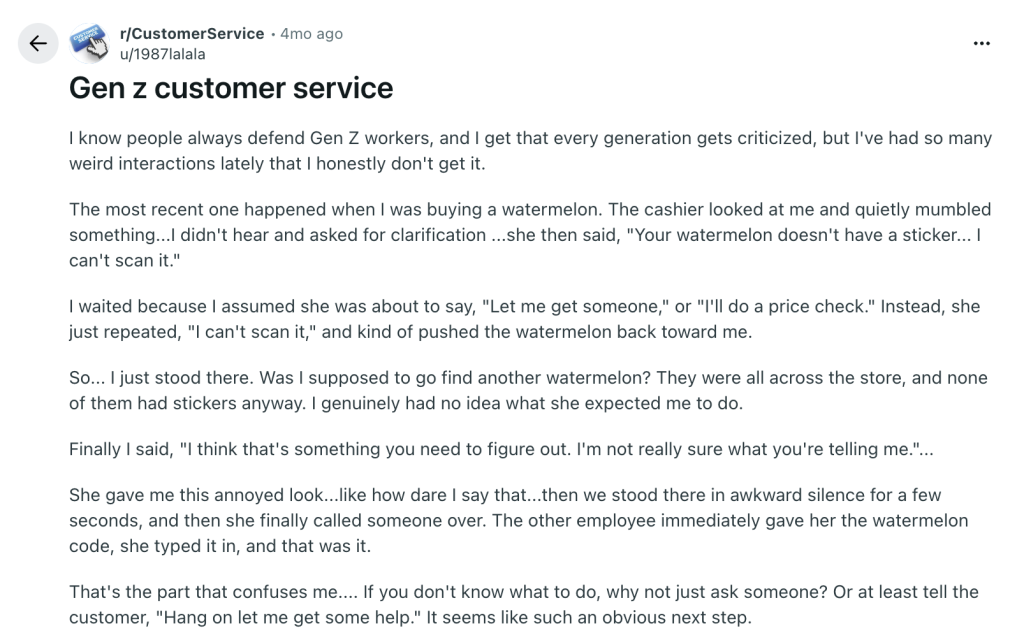
In one Reddit discussion, a customer described trying to buy a watermelon that didn’t have a barcode sticker. The cashier couldn’t scan it but didn’t suggest a solution or offer to get help. Another employee eventually supplied the code, and the transaction went through.
The problem was the lack of initiative after the problem became apparent, rather than the literal missing sticker. The customer was left to figure out what should happen next, even though the employee was better placed to resolve it.
Customers don’t expect every agent to know every answer. They do expect someone to take responsibility for finding one.
For support teams, this means taking ownership of the next step, even when you can’t resolve the issue yourself. Explain what you’ll do, who needs to be involved, and when the customer can expect an update. If a ticket needs to move to another team, make sure the handoff happens instead of leaving the customer to chase it.
For customers, it means recognising that an agent may need to investigate or consult someone else before answering. A clear explanation of the next step is often more useful than an immediate response that solves nothing.
Courtesy makes an interaction bearable; ownership makes it productive.
2.
Self-service should reduce effort, not create another obstacle

Automation has made it easier for businesses to handle routine questions without involving an agent. But customers don’t necessarily care whether an answer comes from a person, a chatbot, or a knowledge base. They care whether it helps them solve the problem.
In a discussion about Amazon Prime, a customer described struggling to find a way to initiate a chat or phone call to resolve an order issue. The lack of access to a person was frustrating enough to make them consider switching retailers, even if the alternative cost more.
The frustration here wasn’t necessarily about automation itself. It was about being unable to get help when something went wrong.
A separate discussion in r/CustomerSuccess explored whether AI tools could actually solve customer support problems. One contributor described using AI to draft replies to repetitive questions, with an agent reviewing the response before it went out. Other commenters emphasized that AI works best when it handles a defined set of questions well, uses reliable knowledge sources, and passes useful context to a human when it can’t resolve the issue. Read the discussion on AI and customer support.
These two discussions point to the same principle. Automation should make support easier to access, not harder.
If a customer can find an accurate answer in seconds, that’s a good outcome. If an AI Agent can collect the information needed to create a well-structured ticket, that’s useful, too. But if the customer keeps receiving generic answers or can’t reach a person when the issue needs judgment, automation has become another obstacle.
For businesses, the goal shouldn’t be to automate as many conversations as possible. It should be to resolve routine questions efficiently while making the transition to human support straightforward.
3.
Customers shouldn't have to repeat themselves every time a ticket changes hands
One of the most frustrating things a customer can experience is explaining the same problem to multiple people and discovering that nobody seems to know what happened before.
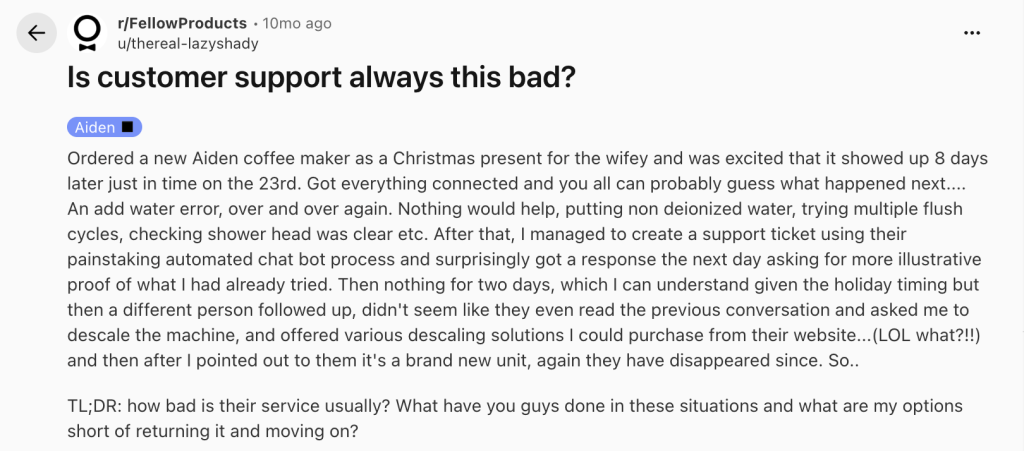
A customer in the Fellow Products subreddit described an issue with a newly purchased coffee maker. After trying troubleshooting steps and contacting support, they received responses that appeared to overlook what had already been discussed. They were asked to repeat information and were given advice that didn’t seem relevant to a brand-new machine.
The product problem was frustrating enough. Having to explain it repeatedly made the experience worse.
This is particularly relevant when requests move between agents or departments. From the customer’s perspective, they’re dealing with one company. They shouldn’t have to understand its internal structure or repeat their history every time a new person joins the conversation.
A good support process preserves the conversation history, troubleshooting steps, decisions, and outstanding actions. The next agent should be able to pick up where the previous one left off.
That requires more than keeping a record of the ticket. Agents need to be able to find the information that matters, understand what has already been attempted, and identify the next step without starting from scratch.
For support teams, this means reading the ticket history before responding and recording notes that are useful to the next person. For businesses, it means connecting conversations and workflows so that information doesn’t disappear during a handoff.
The customer shouldn’t have to become the thread connecting your internal teams.
4.
Fast replies matter, but progress matters more
Response time is one of the easiest support metrics to measure. It’s also one of the easiest to misunderstand.
A quick reply isn’t necessarily a useful reply. If an agent responds immediately but asks for information the customer has already provided, sends an irrelevant troubleshooting guide, or offers no clear next step, the ticket hasn’t moved forward.
The Fellow Products discussion illustrates this problem. The customer had already spent time trying to resolve an issue, but subsequent replies appeared disconnected from the earlier conversation. The delays mattered, but so did the fact that the responses weren’t moving the issue toward resolution. Read the customer support discussion here.
The lesson here isn’t that speed doesn’t matter. Customers shouldn’t have to wait unnecessarily for an acknowledgment or an update. But speed needs to be measured alongside the quality of the resolution.
Support teams should look at how long it takes to resolve issues, how often tickets reopen, how many times customers contact support about the same problem, and whether the original issue was actually fixed.
A team that responds in two minutes but requires five more interactions to resolve a ticket may be creating more work for itself and the customer.
The goal is to help customers get to a resolution with less effort, not simply to make the first response faster.
5.
Good service depends on giving agents the tools and authority to help
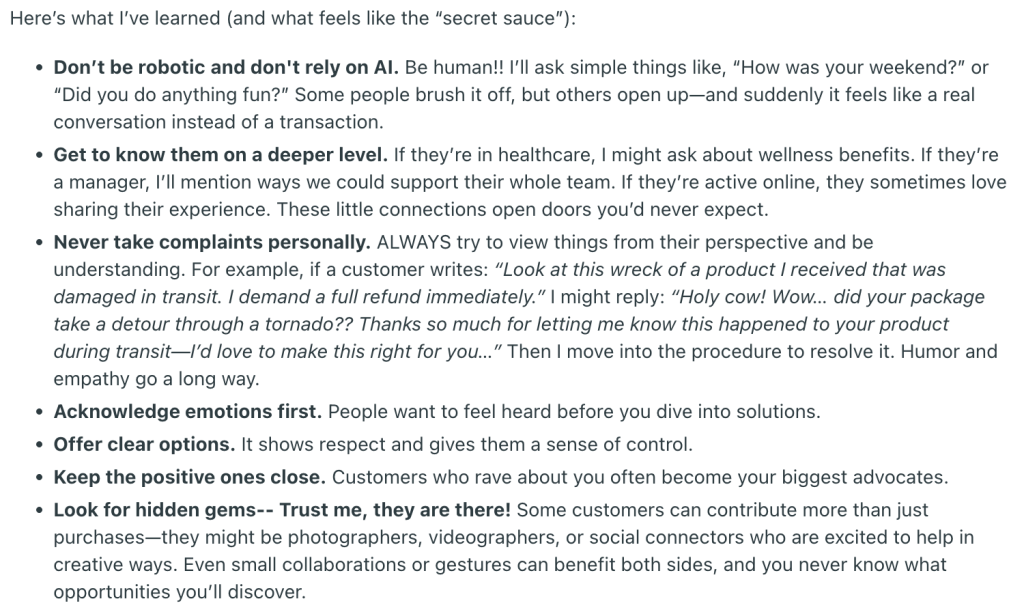
Not every poor support experience comes down to an employee’s attitude or ability. Sometimes, the person expected to resolve the problem doesn’t have the information, permissions, or authority to do so.
Think about what that looks like from both sides. The customer sees a company that isn’t fixing a problem. The agent may be trying to help but has no direct way to contact the team responsible for it. The customer’s frustration is still valid. But blaming the individual agent for every failure misses the operational problem.
Businesses need to give support professionals the tools to do their jobs. That includes access to relevant customer information, clear escalation paths, appropriate permissions, and visibility into what other teams are doing.
If a ticket needs to move from customer support to IT, billing, or another department, someone should be responsible for the handoff. The receiving team should have enough context to act, and the customer should know what happens next.
This is where service operations and customer experience meet. A company can’t consistently deliver good support if its employees have to fight internal processes to resolve ordinary problems.
6.
Empathy has to work both ways
Some customers in these discussions argued that service employees had become dismissive. Others pointed to low wages, difficult working conditions, and the expectation that employees remain cheerful regardless of how they’re treated.
Both sides deserve consideration.
Customers shouldn’t have to accept poor service because a business has failed to support its employees. Support professionals shouldn’t have to accept personal abuse because a customer is unhappy with the company.
This tension comes through in discussions about declining service standards and the conditions frontline employees work under.
Read the discussion about declining customer service standards. And one on working conditions in customer service
Empathy doesn’t mean agreeing with everyone or tolerating unacceptable behavior. It means understanding the other person’s situation while being clear about what can and cannot be done.
For customers, that means explaining the problem without attacking the person helping them. For support teams, it means acknowledging the inconvenience, communicating honestly, and setting boundaries when necessary.
For businesses, it means recognizing that employees can’t consistently provide thoughtful service when they’re overwhelmed, lack the authority to resolve issues, or are measured only on speed and ticket volume.
Good service is a shared responsibility, but the business has to create the conditions in which it can happen.
7.
Exceptional service is often about paying attention

Not every memorable support experience involves a refund, a big compensation package, or an elaborate apology. Sometimes, it comes down to noticing something small and taking a thoughtful extra step.
One customer shared a story about ordering from their usual Chinese restaurant. They tried chow mein instead of their usual lo mein. The restaurant called to check that the change was intentional and then included their usual lo mein at no extra charge, with a note explaining it was there just in case.
Read the discussion about memorable customer experiences.
The restaurant noticed a change, checked rather than assumed, and did something thoughtful. The customer remembered the experience long after the meal.
For support teams, proactive service can take many forms. It might mean noticing that a customer has contacted support about the same issue twice, following up before they have to ask, or explaining a delay before the customer comes looking for an update.
It doesn’t mean anticipating every possible need or going overboard with gestures. It means paying attention and removing unnecessary effort when you can.
What these 15 Reddit threads really taught me
The biggest takeaway isn’t that customer service is getting worse or that customers and agents care less. These discussions show that people want their time, effort, and circumstances to be respected.
Customers want their problems taken seriously. Support agents need the tools and authority to resolve them. Businesses need to make the process easier for both.
Good customer service isn’t about making every interaction delightful. It’s about helping people without making them fight the process, whether that means taking ownership, giving a clear answer, or finding someone who can help.
The person asking for help shouldn’t have to fight the process, and the person providing it shouldn’t have to fight the organization.
Methodology
This article is based on a qualitative review of 15 Reddit threads about customer service. The discussions cover customer complaints, support agents’ perspectives, and examples of exceptional service. We grouped related observations into broader themes rather than treating individual posts as representative of all customers or support professionals. For transparency, here are all 15 threads reviewed as part of this analysis: Thread 1, Thread 2, Thread 3, Thread 4, Thread 5, Thread 6, Thread 7, Thread 8, Thread 9, Thread 10, Thread 11, Thread 12, Thread 13, Thread 14, and Thread 15.