
I analyzed 20 “Customer Service Manager” job descriptions across industries, and geographies. I simply ran a jobs search on LinkedIn and parsed the job descriptions through an AI engine to identify patterns. Certain customer service skill requirements vary by industry, but once you zoom out, the same handful of skills keep showing up irrespective of seniority, geography, or industry. Dive in to see what these customer service skills are that every support team is looking for.
Communication is everything
The first thing that stands out is communication. Almost every listing calls for someone who can work across phone, chat, and email, often switching between them within the same shift. HubSpot’s success posting asks candidates to adapt to fluctuations in inquiry volume while keeping every response thoughtful and complete. That is a real skill. It means writing clearly under time pressure, reading tone accurately, and adjusting your language for a frustrated customer versus a curious one. Companies are not just asking for good grammar. They want agents who can carry a conversation from confusion to resolution without losing the customer along the way.
Critical thinking and problem solving
Right behind communication is problem solving, and specifically the kind that holds up under pressure. Job after job asks for people who can troubleshoot, reproduce issues, and dig into root causes rather than settling for a surface fix. A listing from Shopflo asks agents to understand API responses and use tools like the browser console and Postman to track down bugs. That shows a shift from the old idea of a support agent reading from a script. Today’s agent is closer to a first-line investigator. They need curiosity, patience, and enough technical comfort to ask the right questions before escalating.
Technical skills and tool knowledge
Technical fluency shows up constantly too, and it is more specific than people expect. Postings explicitly mention tools like Freshdesk, Zendesk, Desk365, and Zoho by name, along with basic SQL or dashboard literacy. Nobody expects an agent to code, but nobody wants an agent who freezes at the sight of a ticketing system either. This tells you something about how support has changed. Agents are working inside platforms that hold customer history, automation rules, and escalation paths, and knowing how to move through that system fast is now a core skill, not an extra.
Cross-functional collaboration
Collaboration is usually phrased as working across product, sales, or engineering teams. Support does not sit in a silo anymore. Agents are expected to flag bugs to product, pass on upsell signals to sales, and document recurring issues so the next agent does not start from zero. That means a good support hire needs to think beyond their own ticket queue and understand how their work connects to the rest of the business.
Empathy
And then there is the one skill that shows up in every single posting, even when it is not spelled out directly: Empathy. Companies phrase it differently. Some call it a customer-first mentality; some call it emotional intelligence, but it all points to the same thing: agents need to genuinely care about the person on the other end of the conversation.
Kenneth Gonzalez, a longtime ITSM advisor who has worked as an analyst, a vendor, and now an independent consultant, put it simply in a recent interview with us. He said the real skill people need going forward is relating to and addressing the needs of other humans, and that this is not something AI can replace. His point was that agents who approach a ticket with an “I really care” mindset, instead of treating the customer like a case number, defuse tense situations before they escalate. That same approach, he added, protects agents from the burnout that comes with being treated poorly by the people they are trying to help. You can read the full conversation here.
“If you have people who are genuinely good at managing relationships and cultivating empathy, that “I really care” orientation rather than “what’s your employee ID,” it diffuses situations instead of letting people be abused by the customers they’re trying to support, which is what fuels burnout. This is a real opportunity to shift not just what it’s like to be an IT worker, but what it’s like for customers to interact with IT generally.”
– Kenneth Gonzalez, speaker, advisor, and former Gartner analyst
So what separates a good support agent from a great one? It usually comes down to this mix. Clear communication, sharp problem solving, comfort with the tools of the trade, a collaborative mindset, and real empathy for the customer. None of these skills work in isolation. A great troubleshooter who cannot communicate clearly will frustrate customers just as much as a warm, empathetic agent who cannot navigate the helpdesk software.
These customer service skills are what separate a good helpdesk from a great one. A state of IT helpdesk study we recently ran showed that helpdesk agents care most about ease of use when they evaluate a support tool.
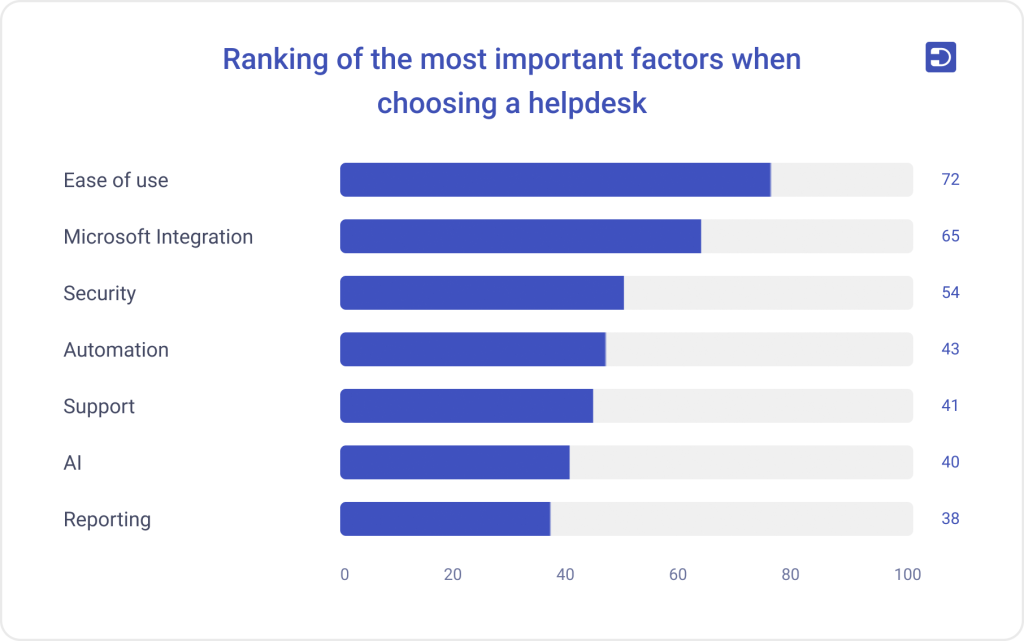
That tells you the platform matters just as much as the person using it. Pairing strong human skills with a helpdesk that is actually simple to work in is how support teams turn good service into great service. That is the philosophy behind how we build Desk365. Signup for a 21-day trial or request a demo to see for yourself.




 AI Agent
 Asset Management
 Knowledge Base
 Automations
 SLAs
SLAs
 Customization
 Ticket Assignment
 Reports & Analytics
 Approval Management
 Helpdesk Security
 Explore All Features
 Banking and Finance
 Healthcare
 MSP
MSP Government
  Non Profit
 IT Services
 Customer Support
 Human Resources
 Facilities