
Great support has never been just about resolving tickets. It’s about understanding people, building trust, and creating services that help organizations achieve more.
Over the years, the role of IT support has evolved from simply keeping systems running to becoming a strategic function that shapes user experiences and business outcomes. But behind every great service desk are the people who understand that technology is only one part of the equation.
Humans of Support is our interview series where we bring forward the experiences, lessons, and perspectives of the people shaping the future of support and IT service management.
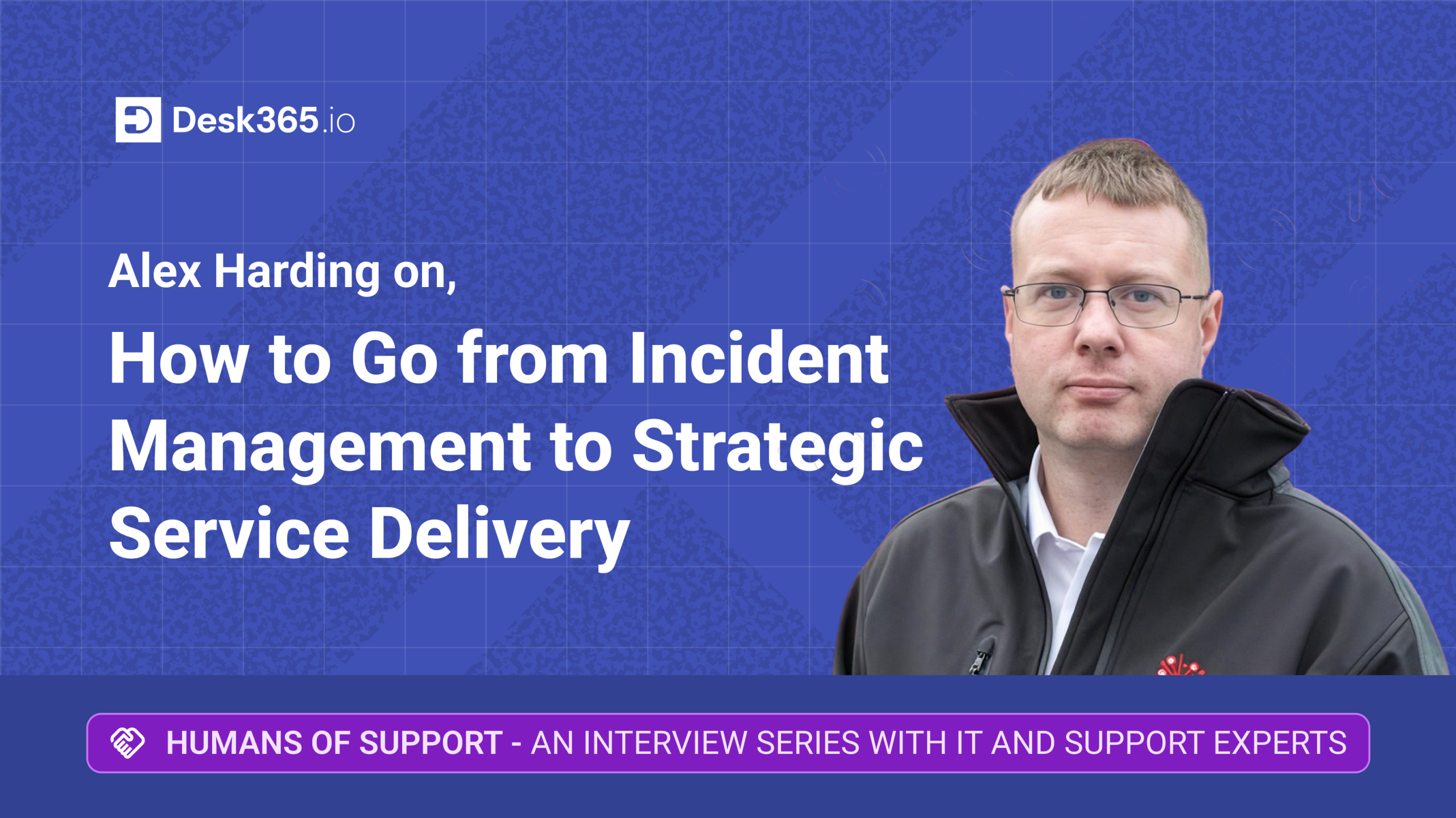
In this episode, we speak to Alex Harding, Head of IT Services at Runshaw College, an ITIL ambassador, and a judge for the Service Desk Institute Awards. Alex has spent 20 years at Runshaw, starting as a systems analyst and rising to lead IT services for around 6,000 students and staff with a team of just 16. He shares his perspective on strategic support, building great teams, judging service desk awards, and why empathy might be the most underrated skill in ITSM today.
You've experienced IT from different levels of responsibility. How does your approach change when you move from managing your own area of IT to leading IT services more broadly? What becomes more important as your responsibilities grow?

What's got to change is your mindset. You've got to quickly realise that actually it's about the bigger picture, outcomes, not just the outputs of one team.
Alex Harding, Head of IT Services at Runshaw College, an ITIL ambassador
I think what changes is yourself. What’s got to change is your mindset, and you’ve got to quickly realise that actually it’s about the bigger picture. It’s about outcomes, not just the outputs of one team, not just the intricacies of how one silo, development or infrastructure, might work.
If you think about my role, starting off as a systems analyst and systems developer, that’s all about your individual project, the one thing you’re working on at that moment. It can be very siloed, very single-focus. And it’s great, and it’s valuable work. I would deeply love to jump back into something like that sometimes.
But now my time is more about people, about process, about how technology is governed, how everything fits together, and what the experience is right across the piece. Not just that one development, but how that development fits with the infrastructure, how we thought about the end user, how we got the feedback, and how we understand what actual problem it’s going to solve in the wider world.
In your current role at Runshaw College IT Services, what does delivering a great IT service actually look like? How do you balance the needs of users, the organization, and the team delivering support?
Our mission is that great education can change the lives of our students, and that's at the heart of what everyone in the college is doing. That's what we use to make decisions and to prioritise.
A lot of the time, IT and other support functions, when it’s all working well, are invisible, in the background, and that’s great. But equally, our staff and students should know we’re here to support their teaching and their learning. Our aim is to take the friction away from them so they can do their jobs, or so students can focus on learning.
In total, there’s probably about 6,000 users we support, just over 5,000 students and around 600 to 700 staff, depending on the time of year. And we’re a small team: 16 people covering everything from service desk, infrastructure, and cybersecurity to in-house development and supporting partner teams in facilities, finance, and catering.
So we’re always doing that balancing act, always looking at what truly is a priority, but being open about it. It’s really about spinning those plates in a way that stays focused on the core mission of the business you’re in.
The service desk is often seen as the place people go when something breaks. How can IT leaders position support as a more strategic function that contributes to wider organizational outcomes?
If you look at our statistics over the last 10 years, at the start about 50% of our work was incidents. Now it's less than 10%, and in some months sub-5%.
This is something we’ve really worked on over the last 10 years, and it’s about helping senior leaders and teaching managers realise that we’re all in this together. Almost every business is now a technology business. When I started here in 2006, technology was important, but it wasn’t everywhere. Now every member of staff has a laptop, every student has a device, and we’ve got 20 or 30 PC suites across the college.
It’s about your service desk staff deeply understanding the business and being able to talk to the business the way the business talks. Our staff go out and join school meetings to understand the pain points, and we bring that feedback back to continuously evolve the operation. Our operation looks nothing like it did a year ago, two years ago, five years ago.
If you want to be a strategic partner, it’s not just about resolving tickets or being there when something’s broken. It’s about people being able to trust you. Volumes have increased, but incident volumes have decreased, because a lot of the time we’re helping people succeed, training people, and supporting them to innovate in their own areas. That’s where the value comes from.
What makes a strong support team? When building or developing a support team, what qualities do you value most? Are there particular skills or behaviours that separate a good service desk from a genuinely great one?
A lot of technology we can teach. A lot of process we can teach. But has that person got a real grounding in customer service and people skills?
When we interview for service desk analysts or leads now, a lot of what I want to consider is whether that person has a real grounding in customer service and people skills. If you’re technology-minded with a genuinely good sense of customer service, you’re going to go a long way in this industry.
Curiosity is huge, never just accepting “that’s the process, we follow it 600 times a week.” You want someone who says: I’ve done this same ticket 10 times, the outcome’s fine and the customer’s happy, but what if we automated it? What if we brought this demand in a different way?
Empathy comes right to the top of the league table. Even though our incident volumes are low, when a technology problem is stopping someone teaching a class of 30 students, or a student can’t finish an assignment with the deadline looming, empathy, and owning that ticket all the way through, matters enormously. Add great communication skills, and the fact that we can’t get away from being continuous, lifelong learners in 2026. The systems and ways of working we have today probably won’t look the same even a few years from now. That’s what makes a great analyst, not just being good with the technology, but bringing culture and people into it too.
As a judge for the Service Desk Institute awards, what do you look for when evaluating service desk submissions? What separates organizations that simply report good metrics from those that can demonstrate meaningful improvements in customer, service, and business outcomes?
Everyone can have great technology and wonderful-looking dashboards. For me, it's seeing under the hood: do those metrics have some deep meaning behind them?
I was invited to be a judge the year after we won Best Service Desk, and it’s become one of my favourite times of the year. It’s an incredible journey of discovery. I end up with hundreds of notes and Post-its stuck all over my desk.
Everyone can give great technology, everyone can have a great tool and wonderful dashboards and stats. But for me, it’s seeing under the hood: do those metrics have real meaning behind them? Is this a service desk that’s going the extra mile for customers and genuinely changing outcomes for them? Are they taking on the technical and cyber risks of the business and working hard to reduce them, while being smart about how they build capacity, a real mix of humans and automation, without losing empathy?
At the end of the day, you’ve got to have the stats to back it up, but there has to be a story. Interestingly, every organization that’s won since we did, I’ve come away thinking, “I could work there.” There’s a real feel that they understand what they’re doing and are articulating it well, and that’s what shines out for me.
2006, 2016, 2026: How has support changed?
In 2006 the teams were very siloed and it was all about keeping the lights on. By 2016 we were thinking about service. In 2026, we're in an experience and outcome world.
In 2006, I was fresh out of university and technology was part of the college, but the teams that managed it were very siloed. The development team barely had contact with infrastructure, and there was no single service desk. Teams were technology-centric, and it was mostly about keeping the lights on.
By 2016, things had shifted towards a more service-centric world: ITIL and service management practices becoming de facto standards, the start of self-service, and the start of thinking about metrics and measures beyond just uptime and resolution times.
In 2026, we’re in a different world again. We’re in an experience-and-outcome world: what does support feel like, and what does it enable the business to do? Technology is an enabler now, and people care less about structure and silos. Cybersecurity has changed enormously too, from a virus popping your CD drive out to ransomware and espionage being entire industries in their own right. The scope of what an IT service does now is worlds apart from 20 years ago, and the industry is moving faster than it ever has.
AI: boon or bane?
AI should take away friction. It should amplify us as humans. It should never replace our judgment.
We should see it as a boon, though there are definitely elements of a bane in there too. If we step back and look at outcomes while remembering people, AI and automation already have their place. We’ve fully automated things like password resets that used to be bread-and-butter service desk work.
AI is a strategy, not just a capability, and we need to weave it into how we work. In our team, we’ve built a problem management agent, we call it Bobby, that looks back over incidents every few hours, then over the day, then the week, spotting patterns humans might miss. It’s helping to triage tickets, refine changes, and spot connections between tickets that came in on different shifts. It flags what it finds into a Teams chat for a human to check.
Our AI triage tool has halved our triage time, and it’s running at around 95% accuracy, comparable to a mid-level analyst, but a human still makes the final call every time. So you’re still getting 100% accuracy, but 95% of the routine work has been taken away. That’s augmentation, not replacement: our student numbers have grown massively, but the team hasn’t, and AI is helping us pick out what matters, especially what’s affecting teaching and learning, so we can solve it first.
What is one ITSM trend that you think is genuinely underrated right now?
Service empathy. We're all talking about AI, automation, tools, platforms, and cloud, but investing in understanding your customers' journeys is the underrated one.
I often use this example when I guest-lecture students in business, IT, or cyber courses. As a 19- or 20-year-old joining the industry, I’d always loved technology and coding, but I probably wasn’t that interested in people. I thought it was all about sitting in a dark room, coding away. There are roles like that, but more and more of them sit inside businesses now, not apart from them.
Service empathy is the underrated skill. We’re all talking about AI, automation, tools, platforms, and cloud, but investing in understanding your customers’ journeys, what causes them pain, sometimes emotional pain, is what really matters. To us as technology professionals, a user’s frustration with “not knowing how to do X in an application” can feel minor. To them, that frustration builds and builds.
“Knowing our customers” is the actual tagline for our customer experience strategy: personas, journey mapping, improvement work, all of it comes back to knowing your customers and what they’re trying to do. It’s not just a technology problem. This kind of systems thinking, looking at the whole picture and not just the architecture, has been around for a long time. We’ve maybe just never fully engaged with it.




 AI Agent
 Asset Management
 Knowledge Base
 Automations
 SLAs
SLAs
 Customization
 Ticket Assignment
 Reports & Analytics
 Approval Management
 Helpdesk Security
 Explore All Features
 Banking and Finance
 Healthcare
 MSP
MSP Government
  Non Profit
 IT Services
 Customer Support
 Human Resources
 Facilities