
IT service management has changed significantly over the years, with the focus shifting from managing technology to understanding the people and businesses that rely on it.
Humans of Support is our interview series where we speak to the people who have shaped and experienced these changes firsthand.
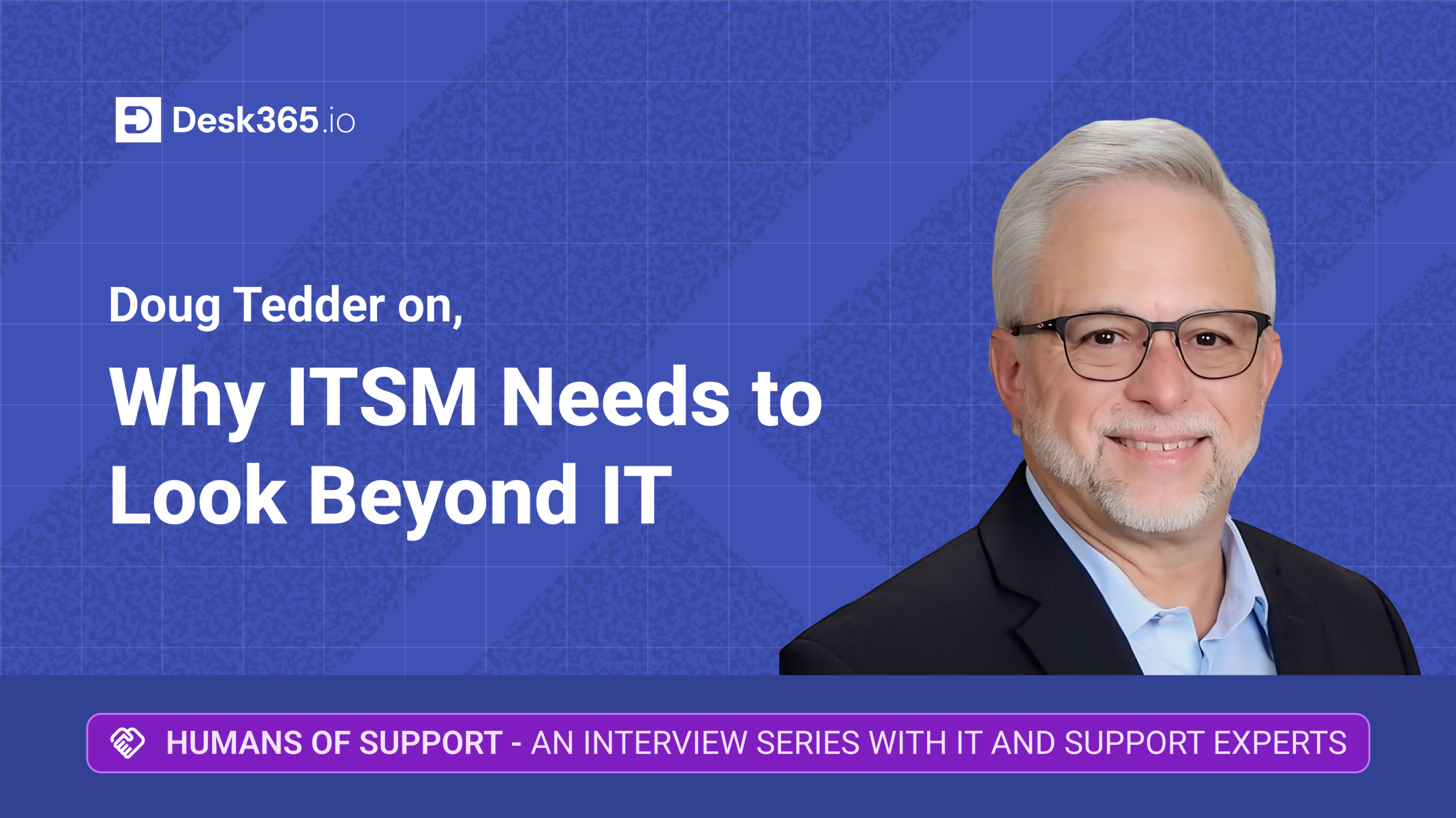
In this episode, we speak to Doug Tedder, an ITIL Master, consultant, trainer, and IT service management veteran. We discuss what organizations misunderstand about ITIL, what good service strategy looks like, how IT teams should measure success, and the skills new IT professionals should develop as AI takes on more repetitive work.
We also talk about how support has evolved over the years and why Doug believes the human aspect of ITSM is becoming increasingly important.
Here’s the full interview with Doug Tedder below.
You’ve spent decades working with ITIL and service management. What do you think organizations most often misunderstand about ITIL, and what does applying it well actually look like in practice?

I think the biggest thing that I've seen over my career is that there's this misconception that ITIL is just about IT operations or quite frankly, even worse, just about the IT service desk.
“Doug Tedder, an ITIL master, trainer, ITSM veteran”
I think the biggest thing that I’ve seen over my career is that there’s this misconception that ITIL is just about IT operations or, even worse, just about the IT service desk. That could be further from the truth.
If organizations really want to apply the guidance that ITIL provides, there’s a couple of things that the organization needs to do.
It starts with understanding the integrated nature of work across and within the organization. What that means is, one, we have to understand the value streams within the organization and how people, process and technology support each step within that value stream.
And then secondly, we need to understand the journeys of consumers that interact with those organizations. So both the consumer inside of the organization, as well as the consumer external to the organization.
The reality is that we can have perfect processes but we could have a dissatisfied or frustrated consumer. And I think that’s the thing that we need to do if we’re going to really apply ITIL best practices.
As an ITSM consultant, you get to see how very different organizations approach service management. What are some of the common signs you see when an organization is executing service strategy well?
I can summarize it very distinctly. It's having a service catalog.
It’s having a service catalog. What I mean by that is a service catalog that actually talks about the business processes that we, from a technology perspective, enable and support.
If I see a true service catalog, not a service request catalog, while those things are important, it really doesn’t indicate service strategy.
When a service catalog is in place, what it really means, and when I say service catalog, it’s got to be agreed.
IT just can’t throw this out and just say, oh, here’s our service catalog.
We need to ensure that we’re working with our organizations to ensure a shared and common understanding of what it is that IT does to support those business processes.
When I see a service catalog, that means that the IT and the non-IT parts of the organization have a good relationship, they understand what each other brings to the business of the business, and it indicates the service strategy is working.
You’ve written about the difference between managing IT and actually delivering business outcomes. Any examples you've seen of IT teams creating real value?
Organizations invest in technology and in IT to get better business results.
I think the first things that IT organizations need to do is understand that the business doesn’t invest in technology to get better technology. Organizations invest in technology and in IT to get better business results.
The first thing is that good service management isn’t about managing IT. It really is about facilitating business value realization and business results. It’s about helping the organization make good business decisions regarding its use of technology and IT.
Here’s what I often see. Many organizations, they continue to be inwardly focused. They measure and report things that mean something to IT, their performance in IT terms, not in business terms.
And these IT organizations are mistaking or managing IT activities for delivering business outcomes. Just because the procedure reached the end successfully doesn’t mean that we delivered a business outcome.
Just because the change went in successfully doesn’t mean the business got its result. And that’s where we fall a little short.
I’ll give you some examples. IT talks about things like availability, which, by the way, is a myth. You can’t measure service availability, but organizations claim that they can.
We measure things like uptime, we measure things like ticket volumes, we talk about response times.
But the issue is that the executives care about things like revenue growth, customer retention, competitive differentiation, customer experience, profit.
This is one of the causal factors for misalignment between IT and the business. We’re not doing the things or we’re not speaking the language that our executives and folks within the business can understand.
Having worked with many IT and service teams, what are success metrics IT teams should measure?
Start with the business outcome, start with business value.
First we have to understand from an IT perspective how our organizations measure success. And then we have to look at how do we contribute to that success. And that’s what we need to measure.
This means that we in IT need to spend more time with the folks that are relying on the products and services that we are providing so that we can understand what’s important and what really matters to the people that are consuming those services.
That doesn’t mean that we should ignore our internal performance measures. There’s always opportunity to improve efficiency or effectiveness or productivity or compliance. And these measures are important to measure and report.
But that doesn’t mean that we lead with those measures. But we relate those measures to the measures that really matter to the organization.
So things like SLAs, one of the most misunderstood metrics that I always encounter, usually SLAs in my experience, are really talking about IT performance, not about the service and not about the business outcomes.
And this is just an example of the kind of things where we have good intentions, like you said, to measure the right things, but we don’t do it well because we don’t understand the things that are going on within our business and why those things are important.
Start with the business outcome, start with business value, understand how the organization measures those things, and then not only measure those things, but align what we are measuring from an internal IT perspective to those business measures and outcomes.
You’ve built your career as an independent consultant, trainer, and thought leader in ITSM. What skills should IT agents just starting their career focus on?
AI is going to solve the easy things, but when people that consume services need to talk to other people, these are where these new skills that I'm recommending will become most important.
That’s a big concern, especially for folks that are just entering the IT industry.
Let’s call it what it is. The elephant in the room is AI. And it’s no secret that AI is going to take on that mundane and repetitive work that many service desks are currently having humans do.
Quite frankly, introducing AI into the service desk, I think, is a great thing. It just amazes me that organizations are wasting the time and the talent, knowledge, skills, and capabilities of the human service desk agents performing those mundane things like resetting passwords and then enabling access to shared folders or cloud resources.
I’m not saying that someone new to the service desk or new to the industry shouldn’t be aware of technology. You should. Get to know what AI can and cannot do.
AI is going to solve the easy things, but when people that consume services need to talk to other people, these are where these new skills that I’m recommending will become most important.
When you think about business acumen, what’s important to the business of the business? Think about how that, if we have that business acumen, think about how much differently we can perform at the service desk.
We understand what’s most important. That means we understand how to prioritize.
That means we understand the impact on the organization. That means that we know to get the right people at the right time with the right knowledge, skills, and those kind of things to take care of that particular issue.
That’s why business acumen is so important.
AI: boon or bane?
It's a boon, right? It absolutely is, I think, a good thing.
It’s a boon. It absolutely is, I think, a good thing. And we need to treat AI, especially from a service desk perspective, as our friend, not our enemy.
But here’s the thing. We’re still trying to understand what AI means, not only to organizations, but to IT itself.
Initially, we’re kind of a couple of years into this big or latest wave of AI, if you will. And I’m seeing fewer and fewer decisions being driven by what I call FOMO, fear of missing out.
But there’s still this misconception out there that AI is some magic wand that can fix issues that we haven’t quite frankly bothered to fix.
In fact, we’ve been ignoring things like broken or non-existent processes, things like poor data, things like strategy that doesn’t quite meet it, siloed behaviors.
That’s one of the biggest things that I continue to see within organizations is that if you think that IT works in a silo, it also happens out inside the organizations.
So if we’re really going to be successful with the AI, and this goes from the organization all the way down to the service desk, those are the things that we have to resolve first.
And this is not an IT issue, but an organizational issue.
Across 2006, 2016, and 2026, three decades, how has support changed at its core?
20 years later, we're starting to realize just how important it is to focus on our support efforts on the people that rely on technology, not just technology.
When I first got involved in service management, from a support perspective, we were very inwardly focused. There was an internal focus on IT.
What’s happened is that we’ve started to shift, especially coming into this decade, the 2020s, we started to shift to a more outside in human centered focus.
That doesn’t mean that outside in thinking is a new and radical concept. We were talking about outside in back in the 2006, 2007 timeframe when I first got involved with service management.
So we were very much focused, earlier in service management around the IT physical plant. Are the servers up and running? How’s the network performing? Are we getting those things done from an operational perspective?
20 years later, we’re starting to realize just how important it is to focus on our support efforts on the people that rely on technology, not just the technology.
So I think that’s the thing that has shifted.
What’s one ITSM trend today that’s genuinely underrated?
It's the human aspect of ITSM. Technology is no longer the differentiator for any organization. And so the differentiator then becomes the human factor.
I would answer that by, it’s the human aspect of ITSM.
We’ve been talking about digital transformation now for probably 10 years, and organizations continue to move in that direction. We’re looking for more and more ways that we’re always on, always connected, the consumer can interact with an organization anytime, any place.
And so as organizations become more digitally driven, this means that technology just becomes table stakes.
Technology is no longer the differentiator for any organization. And so the differentiator then becomes the human factor.
How people interact with and how they feel after those interactions with an organization.
Just think about your last interaction with a company. And if you were doing it through their website or through their mobile app and things didn’t quite work as you expected, you were probably frustrated.
They had great technology, but you didn’t get the outcome that you wanted.
So I believe that this is starting to lead us to a convergence between service management, customer experience, and human-centered design.
Today, most organizations think about those 3 disciplines as being separate, when in fact they need to be considered holistically.
Service management thinks about or delivers how workflows and enables outcomes and value.
Customer experience thinks about what is that human experience along each step that a consumer has in interacting with an organization.
And then lastly, human-centered design. What are those products and services? How do we design the products and services that enable the experience, the value, and the outcomes that humans expect when they interact with us?
So I see that that’s the trend that’s coming. And I think progressive companies are going to start looking in that direction.