
SLA vs. SLO vs. SLI. All three are terms you’ll hear often when talking about service reliability. The problem is they’re also some of the most confused terms in IT.
Here’s a scenario many IT teams have experienced. An outage happens overnight, it’s resolved quickly, and then someone asks whether the SLA was breached. Someone else says it was only the SLO. Suddenly, a simple question turns into a discussion about terms everyone uses but not everyone defines the same way.
If you’ve ever found yourself mixing up these terms, you’re not alone. They sound similar and are closely related, so it’s easy to confuse them. But they each serve a different purpose, and understanding the difference is important. It can mean the difference between missing an internal performance target and breaking a promise you’ve made to a customer.
The good news is they’re actually quite simple once you see how they fit together. Let’s start with an example that has nothing to do with servers.
A fitness tracker explains this better than most engineering diagrams
Picture the fitness tracker on your wrist right now. Three different things are happening on that little screen, and they map onto this whole framework almost perfectly.
The step count ticking up over the course of the day? That’s just a number. It doesn’t know or care whether you’re proud of it. That’s your SLI, a Service Level Indicator. It’s the raw, observed measurement of something happening, with zero opinion attached.
The 8,000 steps-a-day goal you quietly set for yourself back in January? That’s your SLO, a Service Level Objective. It’s the target you chose, based on what felt realistic and healthy for you specifically, tracked over a window of time you also chose.
Now imagine you made a bet with a friend: you owe them twenty dollars if you don’t average 8,000 steps a day over the next month. That’s your SLA, a Service Level Agreement. A formal commitment, made to someone else, with a real consequence attached if you fall short.
Now let’s go through each one properly.
SLI: The number that doesn't lie
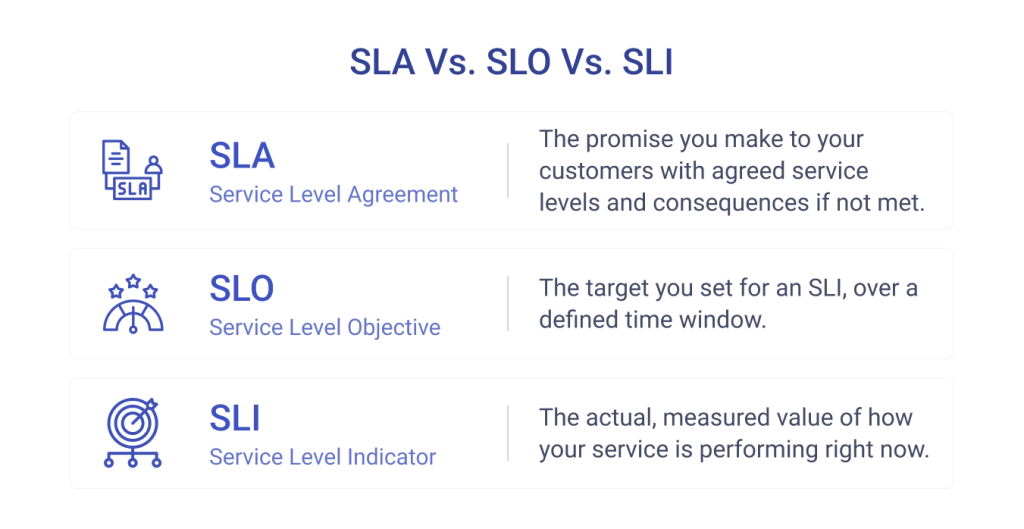
A Service Level Indicator is the actual, measured value of how your service is behaving right now, expressed as a number. Not a goal. Not a promise. Just data.
For a help desk, an SLI measures things like how quickly support tickets are answered, how fast they’re resolved, or how often support commitments are met.
For example, imagine your support team received 1,000 tickets this week. If 940 of those tickets received a first response within one hour, your first response time SLI is 94%.
The SLI doesn’t tell you whether 94% is good or bad. It simply reports what actually happened.
Some common SLIs for helpdesk teams include:
- First response time: What percentage of tickets received a first response within your target time?
- Resolution time: What percentage of tickets were resolved within the expected timeframe?
- SLA compliance: How many tickets met their assigned SLA targets?
- Customer Satisfaction (CSAT): What percentage of customers rated their support experience positively?
- First Contact Resolution (FCR): What percentage of issues were resolved during the first interaction?
The important thing is that an SLI measures something your customers actually experience. For most help desks, that means focusing on response times, resolution times, and customer satisfaction rather than internal operational metrics.
Recommended reading: How to improve customer service response times?
SLO: The bar you set before anyone's watching
A Service Level Objective is the target you set for an SLI, over a defined window of time. It’s internal, the number your team is actually trying to hit, independent of whatever ends up promised to a customer on paper.
This is where a useful one-line test comes from: a good SLO answers “how good is good enough?” Not “how good could we theoretically be”. Chasing 100% reliability on anything is both impossible and a waste of engineering effort that could go toward something users would actually notice.
A real SLO has three parts that all need to be pinned down, or it isn’t really an SLO, it’s just a vibe with a percentage sign:
1. A metric: which SLI is being targeted
2. A target value: the number you’re aiming for
3. A time window: the period you’re measuring across
“We want good uptime” is not an SLO. “We will maintain 99.9% uptime, measured over a rolling 30-day window” is an SLO. The difference matters, because the second version is something you can actually fail, and therefore something you can actually manage.
SLA: The promise you make to your customers
A Service Level Agreement (SLA) is where your internal reliability goals become a commitment to your customers.
Unlike an SLO, which is an internal target, an SLA is a formal agreement that defines the level of service customers can expect. If you fail to meet it, there are usually consequences such as service credits, refunds, or other contractual remedies.
A typical SLA answers four questions:
- What’s covered? Which services or support channels are included?
- What’s being promised? For example, first response time, resolution time, or system availability.
- How is it measured? The key customer service metrics and time windows used to determine whether the promise was met.
- What happens if it’s missed? This could include service credits, refunds, or other compensation.
For a helpdesk, an SLA might look like this:
Priority 1 incidents will receive a first response within 30 minutes, 95% of the time, measured each calendar month.
Unlike an SLO, this isn’t just a goal, it’s a promise made to your customers.
Why your SLO should be stricter than your SLA?
One of the biggest mistakes organizations make is setting their internal SLO and external SLA to the same number.
Imagine you promise customers that 95% of Priority 1 tickets will receive a first response within 30 minutes. If your internal SLO is also 95%, you have no room for unexpected spikes in ticket volume, staff shortages, or system outages. The moment you fall below 95%, you’ve already broken your customer promise.
A better approach is to set your internal target a little higher.
For example:
- SLA: 95% of Priority 1 tickets receive a first response within 30 minutes.
- SLO: Aim for 98%.
That extra margin gives your team breathing room. Most months you’ll comfortably meet your customer commitment, even if a particularly busy day or unexpected incident causes a small dip in performance.
Think of it this way:
- SLI tells you how you’re performing.
- SLO tells your team what success looks like.
- SLA tells your customers what you’re promising.
How the three actually fit together
Read in the right order, it’s almost anticlimactic how simple this is:
You measure something (the SLI). You decide what “good” looks like for that measurement (the SLO). You promise a version of that target to someone else, with a real consequence attached if you miss it (the SLA).
The flow only ever runs in one direction. You can absolutely have SLIs and SLOs with no SLA in sight, plenty of internal tools and free products are run exactly this way, measured carefully with zero customer-facing contract attached. What you can’t really do is have a sensible SLA without an SLO underneath it, because at that point you’re just promising a number nobody is actually tracking, and that tends to go about as well as it sounds.
If you only remember one sentence from this entire post, make it this one: the SLI is what happened, the SLO is what you wanted to happen, and the SLA is what you told someone else would happen, in writing, with a number attached if you’re wrong.
| SLI | SLO | SLA | |
|---|---|---|---|
| What it is | A measurement | A target | A contract |
| Audience | Internal (engineering, ops) | Internal (whole team) | External (the customer) |
| If you miss it | Nothing automatic, it's just a data point | Internal review, error-budget burn | Service credits, refunds, churn risk |
| Example | 99.92% of requests succeeded last week | Maintain 99.9% success over a rolling 30 days | Guarantee 99.9% uptime, or refund 10% of that month's fees |
Common mistakes teams make
Understanding SLIs, SLOs, and SLAs is one thing. Using them effectively is another.
Here are some of the most common mistakes teams make, and how to avoid them.
1. Setting the SLO equal to the SLA
This is by far the most common mistake.
If your SLA promises that 95% of Priority 1 tickets will receive a first response within 30 minutes, your SLO shouldn’t also be 95%.
If both numbers are the same, even a small dip in performance means you’ve already broken your customer promise.
Instead, aim higher internally. For example:
- SLA: 95%
- SLO: 98%
That extra buffer gives your team room to handle unexpected spikes in workload without immediately breaching the SLA.
2. Measuring what's easy instead of what's important
Not every metric deserves to become an SLI.
For example, tracking how many tickets are assigned to each agent might be interesting, but it doesn’t tell you whether customers are receiving timely support.
Instead, choose metrics that reflect the customer experience, such as:
- First response time
- Resolution time
- Customer satisfaction (CSAT)
- Percentage of tickets resolved within target
If the metric doesn’t help answer “Did the customer receive good service?”, it probably isn’t the right SLI.
3. Tracking too many metrics
It’s tempting to measure everything.
The problem is that dashboards filled with dozens of KPIs make it difficult to know what actually matters.
A few well-chosen SLIs are usually far more valuable than dozens of metrics nobody reviews.
Focus on the measures that directly impact your service quality.
4. Setting unrealistic targets
Ambitious targets are good, but impossible targets quickly become meaningless.
For example, promising that 100% of tickets will always receive a response within 15 minutes sounds impressive, but it’s unlikely to hold up during staff shortages, public holidays, or unexpected surges in ticket volume.
Choose targets that challenge your team while remaining achievable.
5. Creating SLAs without involving the support team
SLAs shouldn’t be decided by management or sales alone.
The people who handle the tickets every day understand what’s realistic, where the bottlenecks are, and what customers actually expect.
Involving the support team when defining SLAs leads to commitments that are both achievable and meaningful.
What engineers on Reddit added to the discussion about SLIs, SLOs, and SLAs
After reading the original explanation of SLIs, SLOs, and SLAs, several engineers on Reddit shared practical insights from their own experience. While everyone agreed the article was a great introduction, the discussion highlighted a few important points that beginners often miss.
1. Your SLI should measure what customers actually care about
One of the highest-rated comments pointed out that simply defining an SLI isn’t enough, you also need to choose the right metric.
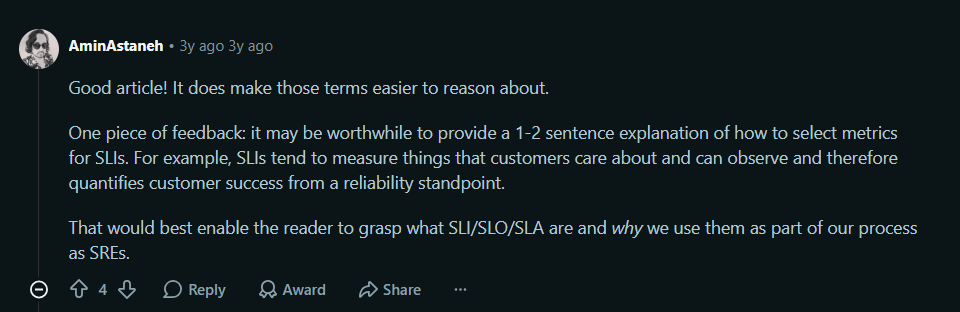
As Reddit user AminAstaneh explained:
“SLIs tend to measure things that customers care about and can observe and therefore quantifies customer success from a reliability standpoint.”
That’s an important distinction.
A metric like CPU usage or memory consumption might tell your operations team that something is happening, but customers never see those numbers. Instead, your SLIs should reflect the customer’s experience.
For example, in an IT help desk, good SLIs include:
- First response time
- Resolution time
- Percentage of tickets resolved within SLA
- Customer satisfaction (CSAT)
These are the metrics customers actually notice when service quality improves or declines.
2. Different services need different SLIs
The original article uses availability and response time as examples, but the discussion pointed out that every type of service has different success metrics.
The article’s author replied:
“We have some backend microservices but are increasingly supporting data pipelines… which have different end users and hence care about different SLIs. For example data quality or data age was something we looked at on the data pipeline side.“
In other words, there isn’t a universal checklist of SLIs.
Different services require different measurements:
| Service | Example SLIs |
|---|---|
| Help desk | First response time, resolution time, CSAT |
| Web application | Availability, page load time, error rate |
| Data pipeline | Data quality, data freshness, pipeline completion |
The key is choosing metrics that reflect what your users value.
3. Your SLO should be stricter than your SLA
Another engineer shared how their organization separates internal goals from customer commitments:
“I’ve had vendors where they have an SLO which is their internal target and the SLA’s to be the SLO’s with a greater threshold for triggering payouts due to a breach.”
This reinforces one of the biggest best practices in reliability engineering:
Don’t make your SLO and SLA the same number.
For example:
- SLI: First response time
- SLO: 98% of Priority 1 tickets receive a first response within one hour
- SLA: Customers are guaranteed 95%
That small gap gives your team room to handle unexpected spikes in workload before an SLA breach occurs.
4. An easy way to think about an SLO
One commenter suggested that the article’s table could be even clearer by separating the metric from the target.
They wrote:
“Which would then have columns ‘SLI’ and ‘Threshold’, which would fit your description of SLO = SLI + Thresholds.”
That’s a simple mental model that’s easy to remember:
- SLI = What you’re measuring
- Threshold = The target value
- SLO = The SLI combined with its target
For example:
- SLI: First response time
- Threshold: 95% within one hour
- SLO: 95% of tickets receive a first response within one hour
5. Simplicity is a strength
Finally, several engineers praised the article for keeping the explanations short and practical.
Comments included:
“This is really good. Short and sweet. Good examples. Strong primer for beginners.”
and
“Nice. Helpful!“
That reflects a broader lesson in service management.
SLIs, SLOs, and SLAs don’t need to be complicated. Most teams are better served by tracking a small number of meaningful metrics than by filling dashboards with dozens of KPIs that nobody reviews.
What IT support teams can learn
Although the discussion came from an SRE community, the advice applies equally well to IT service desks.
SLI – 92% of Priority 1 tickets received a first response within one hour
SLO Internal goal – 95% of tickets receive a first response within one hour
SLA Customers are guaranteed a one-hour first response, or service credits may apply
The Reddit discussion reinforces a simple idea: choose metrics that customers actually care about, set realistic internal targets, and make customer promises that your team can consistently deliver.





 AI Agent
 Asset Management
 Knowledge Base
 Automations
 SLAs
SLAs
 Customization
 Ticket Assignment
 Reports & Analytics
 Approval Management
 Helpdesk Security
 Explore All Features
 Banking and Finance
 Healthcare
 MSP
MSP Government
  Non Profit
 IT Services
 Customer Support
 Human Resources
 Facilities