
I never thought much about customer support until I had to. On one unusually busy day, I was waiting for lunch to be delivered at work, and what happened changed my perspective.
For context, I just started my first full-time corporate job. My day goes between attending back-to-back meetings and switching between multiple tabs. That fated day, I ordered lunch when I found a 20-minute window. The food app confidently showed “Arriving in 18 minutes.”
“Wow, that would be perfect”, I thought.
18 minutes later, it became “Arriving in 10 minutes.” I was disappointed.
Another 10 minutes later, it was still the same.
My patience crossed miles while my delivery partner barely covered a kilometer.
That’s when I opened the customer support portal of the food delivery app. After jumping through many hoops, I finally got connected to a human agent. I was neither expecting compensation nor a discount – just expecting to hear a reason for the delay.
Instead, the conversation ended up being templated, with no resolution in sigh. With a 25-minute delay, my food was finally delivered. When I opened the package, I realized I got the wrong order after all that delay.
My hunger and frustration knew no bounds. Two things matter to me during these moments: a quick response and empathy. And that’s what shapes all of Gen Z customer support expectations.
At that moment, the delayed delivery wasn’t what bothered me the most. Mistakes happen. Traffic happens.
What disappointed me was the feeling that nobody seemed to care.
What Gen Z expects from customer support today
This experience made me realize something.
Gen Z customers understand the challenges businesses face. Most customers know that support teams deal with high ticket volumes, staffing challenges, and operational constraints. But there are certain factors which are non-negotiable in customer support from a Gen z’s perspective.
We want faster responses
One thing Gen Z customers dislike is waiting without updates.
Delays happen, but without communication, every delay feels worse than it actually is.
This is why live chat, instant messaging, and AI-powered helpdesks have become increasingly popular among younger customers. They don’t necessarily eliminate waiting times, but they reduce uncertainty and enable faster responses.
Customers want to know what’s happening, even if a problem cannot be resolved immediately
Self-service support matters more than ever
GenZ likes to be independent. Before I look for help from a human, I’m happy to read help center articles, FAQs, knowledge bases, video tutorials, and step-by-step guides. Provided it has actually meaningful information, of course. In fact, Gartner found that 38% of Gen Z and millennial customers are likely to stop trying to resolve a customer service issue, if it cannot be resolved through self-service support.
This statistic surprised me. But when I thought about my own behavior, it made complete sense. The easier it is to find answers independently, the better the overall customer experience.
Resolved problem should stay resolved
This is where Gen Z customers get really frustrated. Nobody wants to repeatedly contact support for the same issue. Customers expect problems to be resolved completely, not temporarily.
Spend enough time on Reddit, and you’ll find countless examples of customers sharing stories about recurring issues that never seem to go away. A single unresolved problem can quickly become a reason to abandon a product or service altogether.
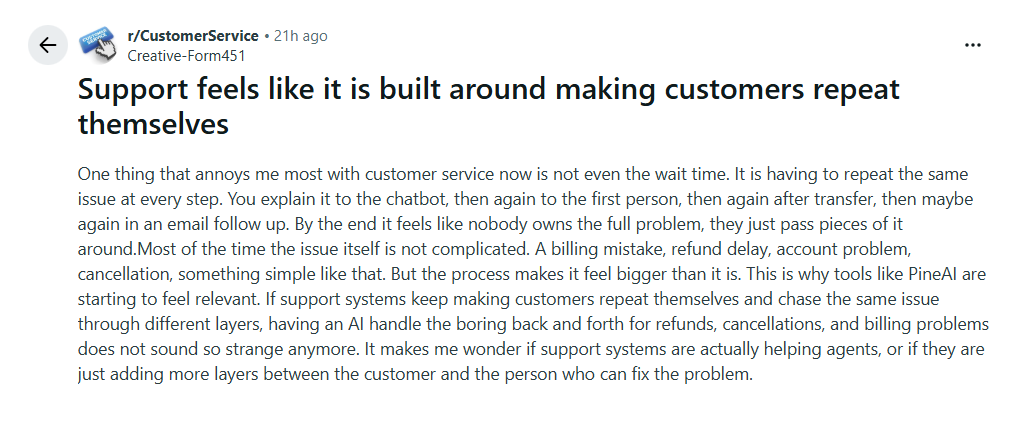
Source: Reddit
Honestly, this comment summarizes what and how customers feel today.
Turn off scripted responses and turn on empathy
Lack of empathy is one of the fastest ways to crush GenZ’s trust in your support and even your business. Customers don’t just want solutions. They want to be heard.
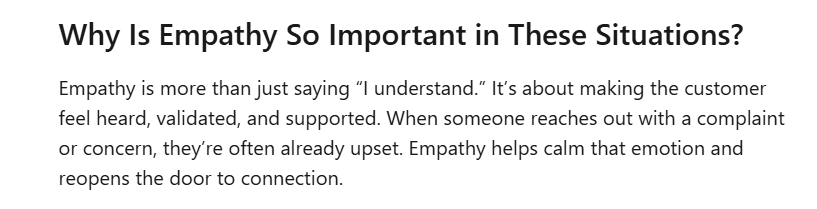
Source:LinkedIn
Most people can relate to this. We’ve all experienced situations where a genuine response mattered more than a perfectly scripted one.
Omnichannel experiences should feel connected
One thing that elevates customer service is having continuity between all support channels.
As a frustrated customer, if I start a support conversation in live chat and later continue it through mail, I shouldn’t have to start from scratch. Gen Z customers frequently switch between channels depending on convenience and expect omnichannel customer service that moves with them.
Whether the conversation starts through chat, email, social media, or a customer portal, the experience should feel connected and seamless.
Convenience transforms into loyalty
There is a simple behavioral pattern among Gen Z customers that often goes unnoticed. They remain loyal to brands that make life easier. If a customer support portal is fast, convenient, transparent and easy to use, the modern customer segment stays loyal to those brands. Because customer support is no longer just a part of the process, it is representative of the product’s experience itself.
Good support creates trust, and trust creates loyalty.
So, what did my missing lunch teach me?
Looking back, my delayed lunch never really taught me patience. If anything, it taught me that customer support can make a bad day either slightly better or significantly worse.
The wrong order or the delay didn’t bother me as much as feeling like no one gave me a genuine explanation. Gen Z customer support need not be perfect. They expect transparency, accountability, and a response that feels human.
Honest communication and timely updates signal something bigger than good customer support. They signal a well-run business.
The more I reflected on Gen Z’s expectations of customer support, the more I realised they aren’t exclusive to one generation. Fast responses, clear communication, self-service options, empathy, and seamless support experiences are things most customers appreciate, regardless of age.
But what Gen Z does differently is make these expectations less negotiable. People of all ages want their concerns to be acknowledged and resolved with transparency and effective communication because nobody enjoys being left in the dark or feeling unheard.
I wonder how different my lunch story would have been if the support had kept me informed. But hey, now that I work at a customer support company myself, all experiences are making it to the blog, I guess.
To conclude, if my food is stuck in traffic, my support experience shouldn’t be taking the same route.
Frequently asked questions
Gen Z do care a lot about customer service as they feel every problem should be addressed instantly. But if your customer service isn’t fast, real, and values-first, Gen Z has already moved on
Customer self-service is a feature or content that lets a customer resolve their issue without getting in touch with the support agent. This includes help centres, knowledge bases, AI chatbots, video tutorials, and customer service portals. It’s the foundation of any modern Gen Z service strategy.
Scripted replies, long wait times, lack of empathy, redundancy of issues and having to repeat themselves across channels frustrates them every time. They expect personalized, efficient support that doesn’t waste their time.