
Frameworks, processes, and technology can give a support team structure, but they do not always tell the full story. The real challenge lies in applying them in ways that make sense for the people, teams, and businesses they are meant to serve.
Humans of Support is our interview series where we put the spotlight on the people who have been there and done that in the world of support and IT service management.
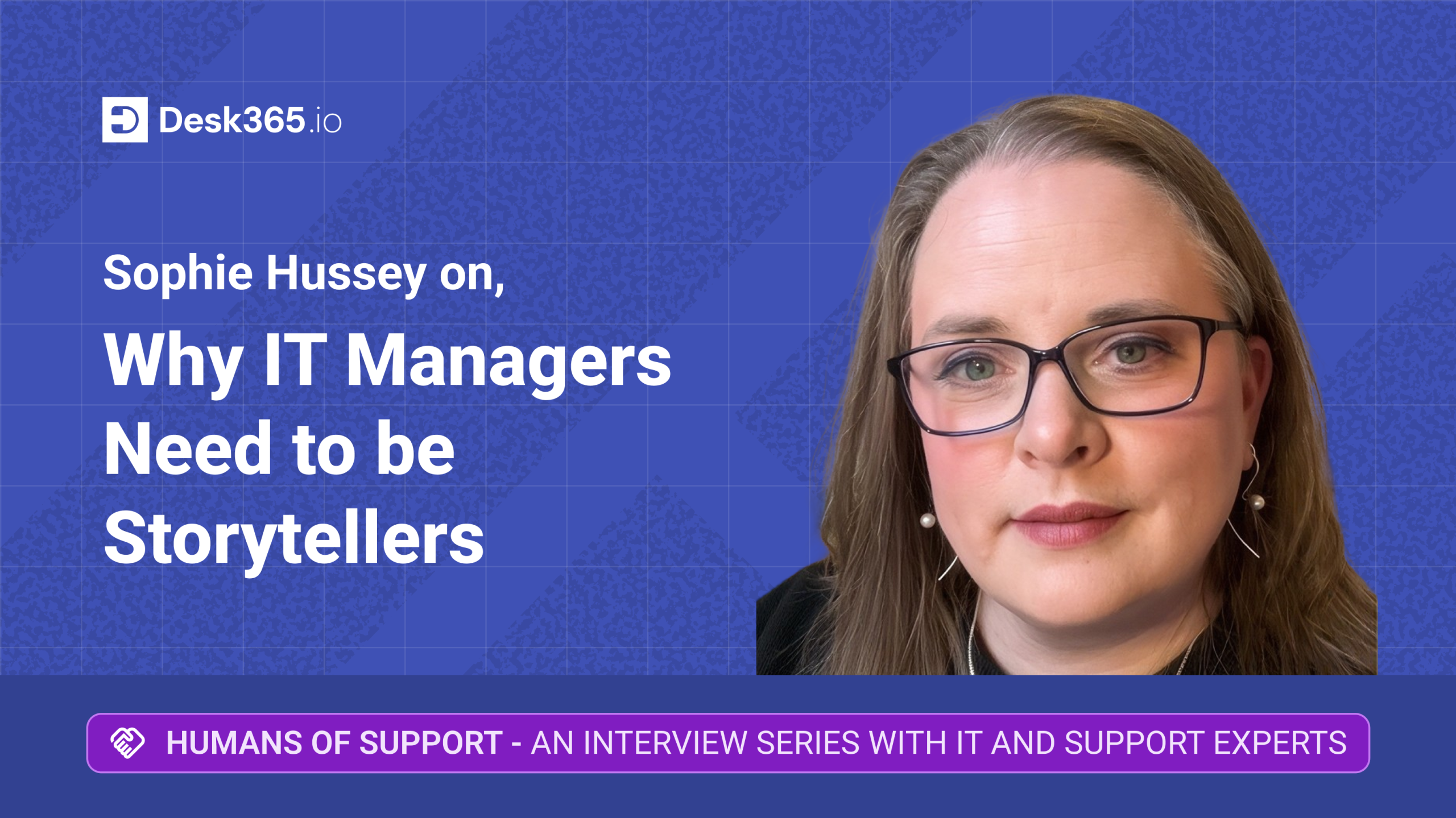
In this episode, we speak to Sophie Hussey, a senior technology and service management consultant, author, mentor, and IT leader with nearly 30 years of industry experience. Sophie shares her perspective on making ITIL practical, strengthening service management skills, and keeping people at the centre as AI evolves.
We also talk about how support has changed over the years, why AI is both an opportunity and a challenge, and why Sophie believes enterprise service management is one of the most underrated areas in ITSM.
Here’s the full interview with Sophie below.
Alex Harding mentioned your workshops was one of the most practical and interactive sessions he's attended. How have you moved away from simply teaching the theory, and what makes your workshops effective?

I'm passionate about taking what's in a book and applying it to real life. Having real-world examples and interactive scenarios goes a long way in helping people understand how things actually work.
– Sophie Hussey, Director, Lapis Consulting Services
I’ve got a history of being involved from a service management perspective, both theory and practical. One of the things I’m really passionate about is taking the stuff in a book and applying it to real life, so that when I’m working with clients or doing workshops, people can actually get involved and think, “Oh, actually, that’s how it works.”
Whilst the theory is great, and some of the newer books are really good at describing how to do things, having a real-world example goes a long way. The workshops I did with Alex and his teams focused on problem management and change enablement specifically.
With problem management, we’re asking people to understand the why and get to the root cause of the issue. So I have a little scenario game that people get involved in. I give them a situation and ask them to start asking questions. As they go through the game, I’ll give them more information so they can work through the problem and understand how it actually works.
You’ve run sessions around change enablement and bringing people along on the change journey. Why do you think organizations still struggle with the people side of change, even when the process and technology are well defined?
“Keep processes alive through regular engagement and advice, making them meaningful to the people who use them.”
Basically, it’s all down to how you socialise it. Most organisations, in my experience, will have a change policy, a procedure, and processes in place. They’ll tell people how to do things once, but you need to keep it alive.
It’s not just about mandatory training that you do every year. As a process owner, you need to keep sharing little tips and advice every month. For example, you could explain what impact and associated risk mean and how they apply in practice. In the same way, when I’m running a workshop or working in an operational role, I’m trying to keep things alive and make them meaningful to people.
I think that’s ultimately what quite a lot of organisations miss. It’s not just about having a process written down in a document somewhere that people can follow. It’s about maintaining it as a living, breathing thing.
When it comes to reviewing a process annually, which everybody should do as a minimum, it’s important to engage people. It shouldn’t just be the process owner looking at it and deciding what needs to change. You need to go out to different teams, whether that’s development, infrastructure, or cyber, and ask them what’s working and what isn’t.
The conversation I always have in those situations is that I can’t promise to give people everything they want if they want the process to change, but I’ll do my best to make it work for them. By involving people and engaging them in these ways, they develop a vested interest in making the process work.
Nobody likes change management as opposed to change enablement, but change enablement is my favourite because it can be the biggest enabler across the board. It’s about socialising the process and bringing it to life for people. In the same way that you might send out a company blog every month, you should do the same for your processes. That way, people might think, “I didn’t think about that. I could do this differently,” or realise that something could help them in a different way.
As an ITIL Ambassador, you’re helping connect the ITIL framework with the realities of modern service management. What does “ITIL in the real world” look like to you?
“People focus on day-to-day service provision rather than what else the framework could do to add real value.”
I think it has so many guises. It differs so much from organisation to organisation. And the things that we speak about in ITIL don’t just sit within technology either. But I know in some organisations, they’ll have it in a finance department, they’ll have it in an HR department as well. So that enterprise service management exists.
I think typically in most organizations where people talk about using ITIL as their framework, or the basis for their framework, you have incident, request, problem, change. If you’re lucky, you’ll have a service catalog and you’ll have an asset management process as well. And you should also, of course, have knowledge.
People don’t necessarily realize what else goes with service management. The other practices that aren’t in that sort of main basic core bunch are often missed, like stakeholder management, like your strategy management, your portfolio management, and all of those other things.
There’s a lot more that the ITIL framework does that organisations don’t realise.
But I would say people typically in organisations focus on that day-to-day service provision and what to do if something goes wrong rather than, hang on a minute, what else in this framework could add some real value to what we’re doing to then help bolster the service we provide and take it from a reactive version to be more proactive and more value add to an organisation.
What do you think service management teams need to do differently to become better translators between technology, the business, and the customer?
We need to bridge the gap between technical teams, the business, and the customer. At the heart of service management, it's about understanding people's needs and delivering value.
I think one of the most important things service management teams need to do is understand how to bridge the gap between technology and the people using it. Quite often, technical teams understand what they’re doing, but they don’t necessarily communicate it in a way that the business or the customer can understand. We need to be able to translate between those different worlds and make sure we’re all working towards the same outcome.
For me, service management isn’t just about the tools we use or the processes we follow. It’s about understanding what the business and the customer need, and making sure that the technology we provide actually delivers value. We need to keep people at the centre of what we do and make technology work for them, rather than allowing the technology to dictate how we work.
What do you think the service management profession needs to do today to make sure we’re building the right skills and attracting the right people for the future?
We need to make service management more visible, accessible, and appealing to the next generation through awareness and apprenticeships.
I think one of the biggest challenges we have is that people don’t necessarily know that service management exists as a career. When young people learn about technology, they hear about infrastructure, cybersecurity, coding, and development, but service management is often missing from that conversation. We need to do more to make people aware of the opportunities available in our profession.
I think we also need to look at how we attract people into the industry. We need to engage with schools, encourage apprenticeships, and explain what service management actually involves in a way that people can understand. Even the job titles and descriptions we use can make a difference. If we want to attract the next generation, we need to make the profession more visible, accessible, and appealing to them.
Across 2006, 2016, and 2026, three decades, how has support changed at its core?
Ultimately, the core of what we do when we provide any kind of support is customer service.
I don’t think it has, really. I think it’s the same today.
When I first started working on a service desk in the year 2000 and what I do today, the stuff that has changed is the technology. The technology has moved on at such a pace.
It’s mind-blowing, certainly, when it comes to any kind of use of artificial intelligence and all of the scary stuff that comes with that in terms of human in the loop and making sure you’re governing it.
But ultimately, the core of what we do when we provide any kind of support is customer service.
You’ve got to be able to facilitate the outcomes that your customer needs. You’ve got to make sure that things are working.
As an IT function, your role is to jointly and collaboratively co-create value for the business and deliver the outcomes.
I don’t actually think that it will ever change in the same way. Working in a restaurant, going to a restaurant, that’s never going to change. You’re going somewhere to receive something from somebody else.
You’re going there for a lovely meal, maybe have a nice drink. You want the staff to be courteous, you want the food to come out on time, and you want things to go the way you want them to. But if something goes wrong, you want the opportunity to say, “Hey, do you know what? My steak wasn’t quite cooked the way I wanted it to,” or “My chips were a bit cold. Please could we do something about it?”
You want to be able to have that opportunity to feed back, and I don’t think that will change at its core.
I think the bit that changes faster than you can really compute, pardon the pun, is the technology behind it.
But I think the thing that I would always say, and I’ve been saying it a lot in the last couple of years, is that we have to focus on people first, then the process, and then the technology, because that’s the cycle that it goes in.
So long as you put the customer and the people, your employees, at the heart of everything you do, the service you provide is always going to be pretty much the same.
AI: boon or bane?
There are cases where using AI will augment what you're doing on a day-to-day basis, and there's so much scope for using agentic AI in the right situation.
I’m a big fan of working smarter, not necessarily harder. There are cases where using AI will augment what you’re doing on a day-to-day basis, and there’s so much scope for using agentic AI in the right situation.
But this is the bit which is scary. When I say I want to talk to somebody at the gas company because there’s some sort of maintenance I need to do in my house, and I then go onto my phone to arrange an appointment and I’m having a conversation with AI, the only responses I’m getting are the bog-standard ones that don’t give me what I want, I want to talk to a human.
I want to talk to a person because I can then relay, “This is what I want to do, this is why it matters to me, this is why it’s important.”
I think quite a lot at the moment, people are getting caught up in the fact that they can work faster by using AI rather than working smarter and therefore keeping the human element.
Things like making sure you have a human in the loop are important. AI is great, but it’s only as good as we define it and design it to be.
What controls and mechanisms are you going to have in place? If you’re going to use agentic AI, how are you going to make sure that the decisions that the agent is making are within your guidance and control mechanisms? And if there is something wrong, what are you going to do about it?
Yeah, it’s both and neither at the same time. I think there’s so many pluses for the use of AI, and I use AI to validate some of the things that I’ve written down. Can you check it for my grammar mistakes? Can you make sure that this is on the tone? Have I missed any references and stuff like that?
But I won’t use AI to write my documentation for me. I won’t use AI to write any of my articles for me.
It’s more as an assistant and an augmentation than anything else. I suspect that the use of AI is just going to go even more through the roof, and a point will come where we as a people will think, “We’ve gone too far. We need to rein it back in.”
What’s one ITSM trend today that’s genuinely underrated?
My biggest one would be enterprise service management at the moment. I think that there's a lot to be said for it.
There’s two things, really. Enterprise service management is one. People talk about it, but they don’t necessarily think about how, holistically, we can use enterprise service management to work consistently across departmental boundaries.
Some organisations do it really well, but others focus too much on the tool. The basic principles we use in ITIL and service management can apply to anything, especially when we think about value streams and how everything fits together.
From a practice and process perspective, the one I’ve been banging on about a lot in the last year is the service catalogue. Not to be confused with the ServiceNow service catalogue, because that’s not the same thing.
The service catalogue can be your central point for everything that makes your life easier, whether you’re onboarding something new, offloading something old, changing something existing, or looking at how you’ve done disaster recovery. It can become your guidebook for how you’re providing services.
And then the other one is CMDB and asset management. I’m yet to see them work effectively because I think people misunderstand what’s involved and how to do it. It’s such a beast that organisations often get to a certain point and then stop.
My biggest one would be enterprise service management at the moment. I think there’s a lot to be said for it. If more organisations thought beyond what technology does, they could really build strength in how their departments work together.