
Most IT teams don’t set out to build their support process around a shared inbox. It just happens that way. Someone creates a distribution list, people start emailing it, and five years later, that’s the whole system.
Someone on Reddit described exactly this:
“My IT department currently has all employees email their tech problems to a generic distribution list in Outlook. The distribution list forwards to all IT guys where we decide via our inbox who takes ownership of each problem.”
That setup has one real problem at its core. Nobody owns anything until someone decides to. Two people can claim the same request. Or everyone assumes a coworker already replied, and three days later, nobody did.
What’s interesting is they weren’t asking for ticketing software. They specifically said they didn’t want people direct messaging each other either, just something closer to a group conversation where requests land, get seen, and get handled without the inbox guesswork.
Microsoft Teams already has the pieces for this built in. In this guide, we’ll walk through what a Teams-based help desk actually is, why it works, how to set one up, and how a tool like Desk365 makes the whole thing native to Teams instead of bolted onto it.
What is a Microsoft Teams helpdesk setup?
A Microsoft Teams helpdesk setup turns Teams into the main place employees go for support, instead of just a place where requests get logged after the fact. Someone asks a question in a channel or messages a bot, and someone, or something, answers, routes it, or escalates it, without anyone leaving the app they already have open.
That can include live chat with an agent, automated answers from a bot, status updates on ongoing issues, and a clear path to escalate anything that needs more attention.
It’s worth separating this from a ticketing system, since the two get used interchangeably a lot. A ticketing system tracks individual requests as records with an owner and a status. A helpdesk covers more ground than that. It includes how available agents look to employees, how fast someone responds, and how a routine question gets answered before anyone has to file anything at all.
That distinction matters once you see what running support this way actually gets you.
Why use Microsoft Teams as a helpdesk system?
Most companies already run on Teams for everyday communication, so a helpdesk built on top of it starts with people who already check it constantly. Employees look at Teams throughout the day anyway, which means a support message has a far better shot at getting noticed quickly than an email sitting in an inbox.
It also keeps a record of every conversation in one place. If an employee follows up on an issue three days later, the agent can scroll back through the same channel or chat and see exactly what was said, instead of digging through old email threads or asking the employee to repeat themselves.
Teams shows presence status too, so an employee asking for help can see whether an agent is available, in a meeting, or away. That cuts down on requests sent into the void with no idea when anyone will actually see them.
Collaboration is built in as well. An agent stuck on a tricky issue can loop in a specialist with an @mention, pull up a shared file in the same window, or jump on a quick call without switching to another tool.
Good reasons to make the switch, sure. But what does the setup itself actually consist of?
How to set up Microsoft Teams as a helpdesk?
A channel works fine for quick questions, but it falls apart once a request needs follow-up. Nobody wants to scroll through forty messages trying to find what happened to a request from Tuesday.
This is where a dedicated tool like Desk365 comes in. It sits inside the same channel your team is already using, but it turns each request into something with an owner, a status, and a history, so nothing depends on someone remembering to scroll back and check.
The channel still feels like a normal conversation. The tracking just happens quietly underneath it. Here’s what that actually looks like once it’s running.
Integrate Desk365 into Microsoft Teams?
Desk365 enables conversational ticketing for Microsoft Teams and allows both your employees and helpdesk agents to discuss and manage all their support requests within Teams.
If you’re already using the Microsoft 365 environment, you don’t need to worry about installing one more piece of external software.
Here are the steps to install Desk365:
1. You have already set up Microsoft Teams for your organization. Now you can install Desk365 in minutes from the Microsoft App Store.
2. At Desk365, we’ve developed two special bots – Desk365 Agent Bot for Microsoft Teams and Desk365 Support Bot for Microsoft Teams.
Agent Bot:
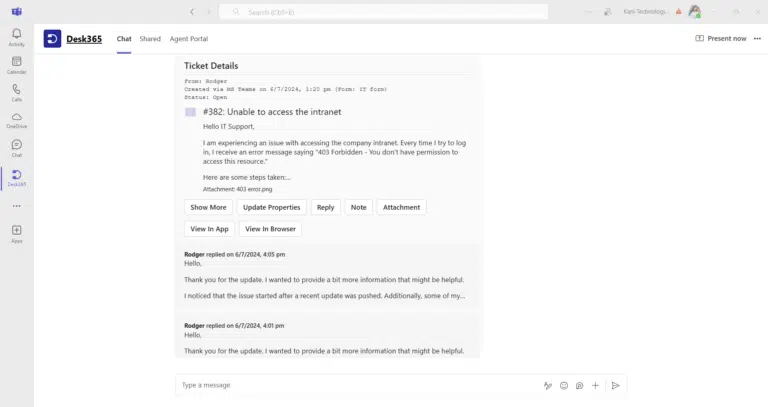
With the Desk365 Agent Bot, your support team can reply to tickets, check on statuses, change ticket properties, and do more, directly in Microsoft Teams. This bot is available only for agents of the company.
This bot is available for free to download. You can find it on Microsoft AppSource.
Support Bot:
With the Desk365 Teams Support Bot, your contacts (employees, customers, end users, students) can create tickets, check on statuses, and respond to agents all from within Microsoft Teams. You can also customize the Support Bot according to your brand guidelines.
Employees can create new tickets and communicate with your support team right within Microsoft Teams.
You’ll need to download the bot and sideload it so all your contacts can use the Support Bot.
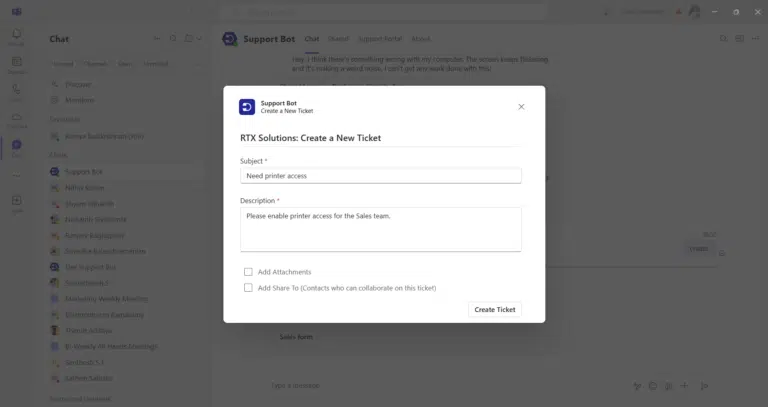
Here is the detailed guide on the installation of Agent Bot and Support bot.
A. How to create a ticket in MS Teams chat using Desk365?
Ticketing stems from where the conversations start.
Desk365 makes it easy to create tickets from incoming messages with a bot. Also, you can convert any messages in a public channel into a trackable ticket in Microsoft Teams and have custom forms for multiple departments.
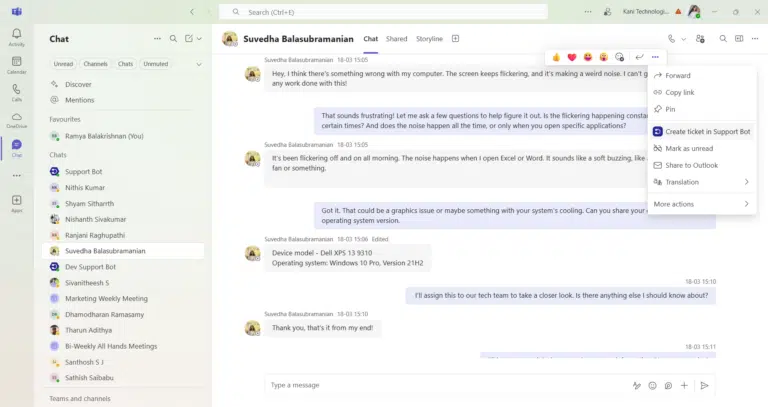
Other than creating tickets from messages, you can also go to the Desk365 Support Bot in Teams and create a new ticket. You can also configure the Create Ticket Form with various fields so you get the right information from your end-users before a ticket is created.

B. How agents can reply to tickets right within Microsoft Teams?
Your IT support team can reply back to tickets, update ticket properties, and do more, directly in Microsoft Teams.
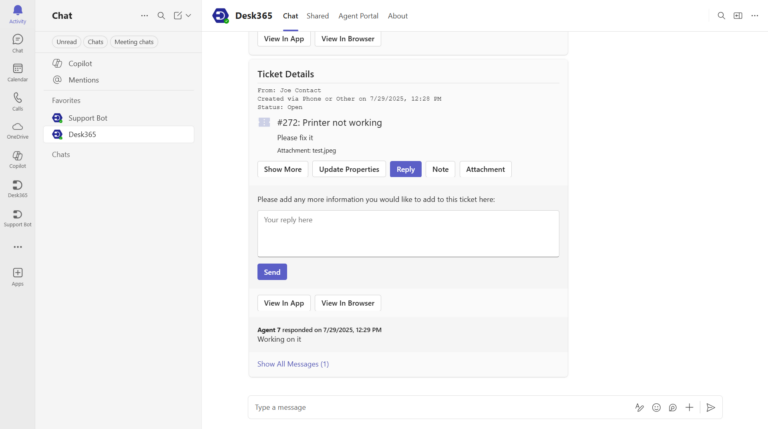
Enjoy the native help desk experience built right into Microsoft Teams using Desk365 so that:
– Your internal employees do not have to leave Teams to submit tickets.
– Your helpdesk agents can reply to the tickets right within Microsoft Teams.
C. How to update ticket properties right within Teams?
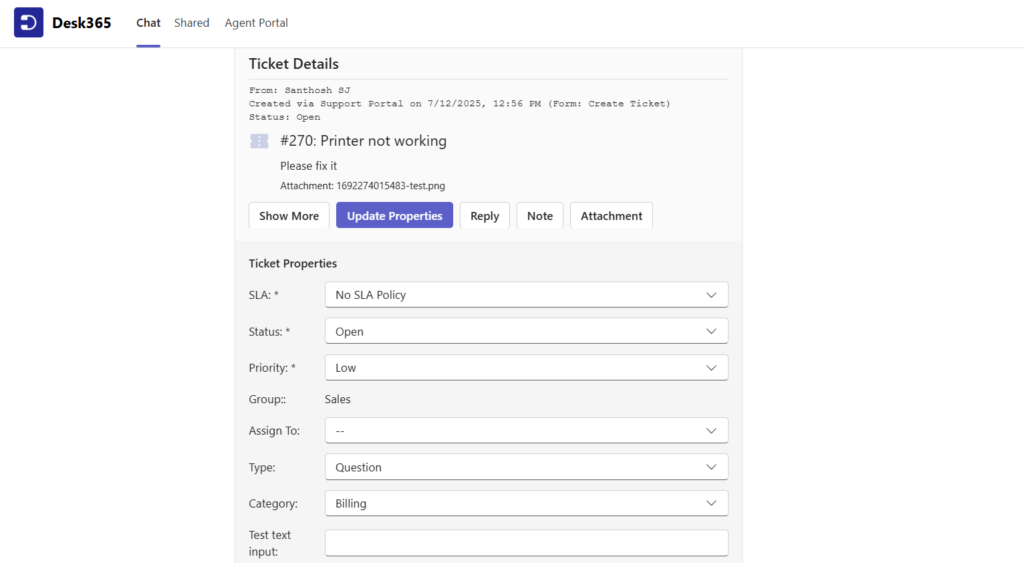
In Desk365, you can update ticket properties directly in Teams. Change the SLA, Status, Priority, Group, Assign To, Type, and Category using simple dropdowns. You can also add notes, reply, or attach files — all without leaving Teams.
What real IT admins say about running support in Teams
It’s one thing to walk through how Desk365 works. It’s another to hear it from someone running it day to day.
Steve Beaudet, a Windows Systems Administrator at Desjardins, put it simply in a five-star review:
His take on support held up too. Every issue he raised got handled.
Best practices for running a helpdesk in Teams
A support channel often carries sensitive information. An employee’s home address for a benefits question, a device serial number, sometimes a screenshot with account details visible. Set channel permissions so only the people who actually need access have it, and keep anything sensitive, like HR requests, in private channels rather than open, team-wide ones.
Role management matters just as much. Agents need enough access to see ticket history and make updates, but giving everyone admin rights across every connected tool creates more risk than it solves. Microsoft Entra ID lets you manage this through groups and roles, so access lines up with what someone’s job actually requires.
It also helps to set clear guardrails on what belongs in a public channel versus a private message. A general troubleshooting question fits fine in an open channel where others can search it later. Anything involving personal or account-specific details belongs in a one-on-one chat or a ticket, not somewhere a wider team can scroll past it.
Switch to the Best Microsoft Teams Helpdesk
Frequently asked questions
Microsoft Teams does not have a built-in ticketing system. However, it can be integrated with various third-party ticketing solutions like Desk365 to create a comprehensive help desk experience within the platform. A modern ticketing system like Desk365 that integrates with Microsoft Teams, allowing users to create tickets, receive notifications, and check statuses directly within Teams. It also supports other channels like email and web forms, providing a unified inbox for all support requests.
To use Microsoft Teams as a service desk, you can integrate a ticketing app, like Desk365, that allows support requests directly within Teams. Start by installing Desk365 in Teams, configuring it for notifications on new tickets, and setting up channels like “Support Requests” where updates can be tracked by your team. You can also enable bots that answer common questions or update ticket statuses to reduce support staff workload. Add the app as a tab for easy access to support resources, and ensure your team knows how to use it. This setup streamlines your support process, keeping everything organized in one familiar place.
With Desk365, creating tickets in Microsoft Teams is straightforward, bringing support management directly into the platform. After integrating Desk365 with Teams, users can submit support tickets without leaving the Teams interface, streamlining the process for both end-users and support agents. Simply type commands or use a form to submit a ticket within the designated Teams channel, like “Support” or “Help desk.” Desk365 then organizes these tickets and notifies agents, who can easily track and respond to requests.






 AI Agent
 Asset Management
 Knowledge Base
 Automations
 SLAs
SLAs
 Customization
 Ticket Assignment
 Reports & Analytics
 Approval Management
 Helpdesk Security
 Explore All Features
 Banking and Finance
 Healthcare
 MSP
MSP Government
  Non Profit
 IT Services
 Customer Support
 Human Resources
 Facilities